
Aone Software - OS Non-Proxy Atomic Sync 2
Aone Software - OS Non-Proxy Atomic Sync 2
Red Hat Customer Portal
Linux Containers have emerged as a key open source application packaging and delivery technology, combining lightweight application isolation with the flexibility of image-based deployment methods.
Red Hat Enterprise Linux implements Linux Containers using core technologies such as Control Groups (Cgroups) for Resource Management, Namespaces for Process Isolation, SELinux for Security, enabling secure multi-tenancy and reducing the risk of security exploits. All this is meant to provide you with an environment for producing and running enterprise-quality containers.
Red Hat OpenShift provides powerful command-line and Web UI tools for building, managing and running containers in units referred to as . However, sometimes you might want to build and manage individual containers and images outside of OpenShift. Some tools provided to perform those tasks that run directly on RHEL systems are described in this guide.
Unlike other container tools implementations, tools described here do not center around the monolithic Docker container engine and command. Instead, we provide a set of command-line tools that can operate without a container engine. These include:
- podman - For directly managing pods and container images (run, stop, start, ps, attach, exec, and so on)
- buildah - For building, pushing and signing container images
- skopeo - For copying, inspecting, deleting, and signing images
- runc - For providing container run and build features to podman and buildah
Because these tools are compatible with the Open Container Initiative (OCI), they can be used to manage the same Linux containers that are produced and managed by Docker and other OCI-compatible container engines. However, they are especially suited to run directly on Red Hat Enterprise Linux, in single-node use cases.
For a multi-node container platform, see OpenShift. Instead of relying on the single-node, daemonless tools described in this document, OpenShift requires a daemon-based container engine. Please see Using the CRI-O Container Engine for details.
While this guide introduces you to container tools and images, see Managing Containers for more details on those tools.
If you are still interested in using the command and docker service, refer to Using the docker command and service for information on how to use those features in RHEL 7.
Containers provide a means of packaging applications in lightweight, portable entities. Running applications within containers offers the following advantages:
- Smaller than Virtual Machines
What's new in mobile device enrollment and management
This topic provides information about what's new and breaking changes in Windows 10 mobile device management (MDM) enrollment and management experience across all Windows 10 devices.
For details about Microsoft mobile device management protocols for Windows 10 see [MS-MDM]: Mobile Device Management Protocol and [MS-MDE2]: Mobile Device Enrollment Protocol Version 2.
What’s new in MDM for Windows 10 versions
- What’s new in MDM for Windows 10, version 2004
- What’s new in MDM for Windows 10, version 1909
- What’s new in MDM for Windows 10, version 1903
- What’s new in MDM for Windows 10, version 1809
- What’s new in MDM for Windows 10, version 1803
- What’s new in MDM for Windows 10, version 1709
- What’s new in MDM for Windows 10, version 1703
- What’s new in MDM for Windows 10, version 1607
- What’s new in MDM for Windows 10, version 1511
Breaking changes and known issues
Frequently Asked Questions
Change history in MDM documentation
What’s new in MDM for Windows 10, version 2004
What’s new in MDM for Windows 10, version 1909
| New or updated topic | Description |
|---|---|
| BitLocker CSP | Added the following new nodes in Windows 10, version 1909: ConfigureRecoveryPasswordRotation, RotateRecoveryPasswords, RotateRecoveryPasswordsStatus, RotateRecoveryPasswordsRequestID. |
What’s new in MDM for Windows 10, version 1903
| New or updated topic | Description |
|---|---|
| Policy CSP | Added the following new policies in Windows 10, version 1903: |
| ApplicationControl CSP | Added new CSP in Windows 10, version 1903. |
| Defender CSP | Added the following new nodes: |
| DiagnosticLog CSP DiagnosticLog DDF | Added version 1.4 of the CSP in Windows 10, version 1903. Added the new 1.4 version of the DDF. Added the following new nodes: |
| EnrollmentStatusTracking CSP | Added new CSP in Windows 10, version 1903. |
| PassportForWork CSP | Added the following new nodes in Windows 10, version 1903: |
What’s new in MDM for Windows 10, version 1809
| New or updated topic | Description |
|---|---|
| Policy CSP | Added the following new policies in Windows 10, version 1809:
|
| PassportForWork CSP | Added new settings in Windows 10, version 1809. |
| EnterpriseModernAppManagement CSP | Added NonRemovable setting under AppManagement node in Windows 10, version 1809. |
| Win32CompatibilityAppraiser CSP | Added new configuration service provider in Windows 10, version 1809. |
| WindowsLicensing CSP | Added S mode settings and SyncML examples in Windows 10, version 1809. |
| SUPL CSP | Added 3 new certificate nodes in Windows 10, version 1809. |
| Defender CSP | Added a new node Health/ProductStatus in Windows 10, version 1809. |
| BitLocker CSP | Added a new node AllowStandardUserEncryption in Windows 10, version 1809. Added support for Windows 10 Pro. |
| DevDetail CSP | Added a new node SMBIOSSerialNumber in Windows 10, version 1809. |
| Wifi CSP | Added a new node WifiCost in Windows 10, version 1809. |
| WindowsDefenderApplicationGuard CSP | Added new settings in Windows 10, version 1809. |
| RemoteWipe CSP | Added new settings in Windows 10, version 1809. |
| TenantLockdown CSP | Added new CSP in Windows 10, version 1809. |
| Office CSP | Added FinalStatus setting in Windows 10, version 1809. |
What’s new in MDM for Windows 10, version 1803
| New or updated topic | Description |
|---|---|
| Policy CSP | Added the following new policies for Windows 10, version 1803:
Security/RequireDeviceEncryption - updated to show it is supported in desktop. |
| BitLocker CSP | Updated the description for AllowWarningForOtherDiskEncryption to describe changes added in Windows 10, version 1803. |
| DMClient CSP | Added ./User/Vendor/MSFT/DMClient/Provider/[ProviderID]/FirstSyncStatus node. Also added the following nodes in Windows 10, version 1803:
|
| Defender CSP | Added new node (OfflineScan) in Windows 10, version 1803. |
| UEFI CSP | Added a new CSP in Windows 10, version 1803. |
| Update CSP | Added the following nodes in Windows 10, version 1803:
|
| AssignedAccess CSP | Added the following nodes in Windows 10, version 1803:
Updated the AssigneAccessConfiguration schema. Starting in Windows 10, version 1803 AssignedAccess CSP is supported in HoloLens (1st gen) Commercial Suite. Added example for HoloLens (1st gen) Commercial Suite. |
| MultiSIM CSP | Added a new CSP in Windows 10, version 1803. |
| EnterpriseModernAppManagement CSP | Added the following node in Windows 10, version 1803:
|
| eUICCs CSP | Added the following node in Windows 10, version 1803: |
| DeviceStatus CSP | Added the following node in Windows 10, version 1803: |
| AccountManagement CSP | Added a new CSP in Windows 10, version 1803. |
| RootCATrustedCertificates CSP | Added the following node in Windows 10, version 1803: |
| NetworkProxy CSP | Added the following node in Windows 10, version 1803: |
| Accounts CSP | Added a new CSP in Windows 10, version 1803. |
| MDM Migration Analysis Too (MMAT) | Updated version available. MMAT is a tool you can use to determine which Group Policies are set on a target user/computer and cross-reference them against the list of supported MDM policies. |
| CSP DDF files download | Added the DDF download of Windows 10, version 1803 configuration service providers. |
What’s new in MDM for Windows 10, version 1709
| Item | Description |
|---|---|
| The [MS-MDE2]: Mobile Device Enrollment Protocol Version 2 | The Windows 10 enrollment protocol was updated. The following elements were added to the RequestSecurityToken message:
For examples, see section 4.3.1 RequestSecurityToken of the MS-MDE2 protocol documentation. |
| Firewall CSP | Added new CSP in Windows 10, version 1709. |
| eUICCs CSP | Added new CSP in Windows 10, version 1709. |
| WindowsDefenderApplicationGuard CSP | New CSP added in Windows 10, version 1709. Also added the DDF topic WindowsDefenderApplicationGuard DDF file. |
| CM_ProxyEntries CSP and CMPolicy CSP | In Windows 10, version 1709, support for desktop SKUs were added to these CSPs. The table of SKU information in the Configuration service provider reference was updated. |
| WindowsDefenderApplicationGuard CSP | New CSP added in Windows 10, version 1709. Also added the DDF topic WindowsDefenderApplicationGuard DDF file. |
| VPNv2 CSP | Added DeviceTunnel and RegisterDNS settings in Windows 10, version 1709. |
| DeviceStatus CSP | Added the following settings in Windows 10, version 1709:
|
| AssignedAccess CSP | Added the following setting in Windows 10, version 1709. Starting in Windows 10, version 1709, AssignedAccess CSP is supported in Windows 10 Pro. |
| DeviceManageability CSP | Added the following settings in Windows 10, version 1709:
|
| Office CSP | Added the following setting in Windows 10, version 1709:
|
| DMClient CSP | Added new nodes to the DMClient CSP in Windows 10, version 1709. Updated the CSP and DDF topics. |
| Bitlocker CSP | Changed the minimum personal identification number (PIN) length to 4 digits in SystemDrivesRequireStartupAuthentication and SystemDrivesMinimumPINLength in Windows 10, version 1709. |
| ADMX-backed policies in Policy CSP | Added new policies. |
| Microsoft Store for Business and Microsoft Store | Windows Store for Business name changed to Microsoft Store for Business. Windows Store name changed to Microsoft Store. | MDM enrollment of Windows-based devices | New features in the Settings app:
For details, see Managing connection and Collecting diagnostic logs |
| Enroll a Windows 10 device automatically using Group Policy | Added new topic to introduce a new Group Policy for automatic MDM enrollment. |
| Policy CSP | Added the following new policies for Windows 10, version 1709:
|
What’s new in MDM for Windows 10, version 1703
| Item | Description |
|---|---|
Update CSP | Added the following nodes:
|
| CM_CellularEntries CSP | To PurposeGroups setting, added the following values:
|
CertificateStore CSP | Added the following setting:
|
ClientCertificateInstall CSP | Added the following setting:
|
DMAcc CSP | Added the following setting:
|
DMClient CSP | Added the following nodes and settings:
|
CellularSettings CSP CM_CellularEntries CSP EnterpriseAPN CSP | For these CSPs, support was added for Windows 10 Home, Pro, Enterprise, and Education editions. |
| SecureAssessment CSP | Added the following settings:
|
| EnterpriseAPN CSP | Added the following setting: |
| Messaging CSP | Added new CSP. This CSP is only supported in Windows 10 Mobile and Mobile Enterprise editions. |
| Policy CSP | Added the following new policies:
Removed TextInput/AllowLinguisticDataCollection Starting in Windows 10, version 1703, Update/UpdateServiceUrl is not supported in Windows 10 Mobile Enterprise and IoT Enterprise Starting in Windows 10, version 1703, the maximum value of Update/DeferFeatureUpdatesPeriodInDays has been increased from 180 days, to 365 days. Starting in Windows 10, version 1703, in Browser/HomePages you can use the "<about:blank>" value if you don’t want to send traffic to Microsoft. Starting in Windows 10, version 1703, Start/StartLayout can now be set on a per-device basis in addition to the pre-existing per-user basis. Added the ConfigOperations/ADMXInstall node and setting, which is used to ingest ADMX files. |
| DevDetail CSP | Added the following setting: |
| CleanPC CSP | Added new CSP. |
| DeveloperSetup CSP | Added new CSP. |
| NetworkProxy CSP | Added new CSP. |
| BitLocker CSP | Added new CSP. Added the following setting:
|
| EnterpriseDataProtection CSP | Starting in Windows 10, version 1703, AllowUserDecryption is no longer supported. Added the following settings:
|
| DynamicManagement CSP | Added new CSP. |
| Implement server-side support for mobile application management on Windows | New mobile application management (MAM) support added in Windows 10, version 1703. |
PassportForWork CSP | Added the following new node and settings:
|
| Office CSP | Added new CSP. |
| Personalization CSP | Added new CSP. |
| EnterpriseAppVManagement CSP | Added new CSP. |
| HealthAttestation CSP | Added the following settings:
|
SurfaceHub CSP | Added the following nodes and settings:
|
| NetworkQoSPolicy CSP | Added new CSP. |
WindowsLicensing CSP | Added the following setting: |
| WindowsAdvancedThreatProtection CSP | Added the following setting:
|
| DMSessionActions CSP | Added new CSP. |
| SharedPC CSP | Added new settings in Windows 10, version 1703.
The default value for SetEduPolicies changed to false. The default value for SleepTimeout changed to 300. |
| RemoteLock CSP | Added following setting: |
| NodeCache CSP | Added following settings:
|
| Download all the DDF files for Windows 10, version 1703 | Added a zip file containing the DDF XML files of the CSPs. The link to the download is available in the DDF topics of various CSPs. |
| RemoteWipe CSP | Added new setting in Windows 10, version 1703. |
| MDM Bridge WMI Provider | Added new classes and properties. | Understanding ADMX-backed policies | Added a section describing SyncML examples of various ADMX elements. |
| Win32 and Desktop Bridge app policy configuration | New topic. |
| Deploy and configure App-V apps using MDM | Added a new topic describing how to deploy and configure App-V apps using MDM. |
| EnterpriseDesktopAppManagement CSP | Added new setting in the March service release of Windows 10, version 1607. |
| Reporting CSP | Added new settings in Windows 10, version 1703.
|
| Connect your Windows 10-based device to work using a deep link | Added following deep link parameters to the table:
|
| MDM support for Windows 10 S | Updated the following topics to indicate MDM support in Windows 10 S. |
| TPMPolicy CSP | New CSP added in Windows 10, version 1703. |
What’s new in MDM for Windows 10, version 1607
NetTime is a Simple Network Time Protocol (SNTP) client for Windows 95/98/Me/NT/2000/XP/Vista/7/8/10 and Server 2003/2008/2012/2016. (32 bit and 64 bit operating systems are both supported)
If you're looking for a program to keep your system time accurate, you've just found it!
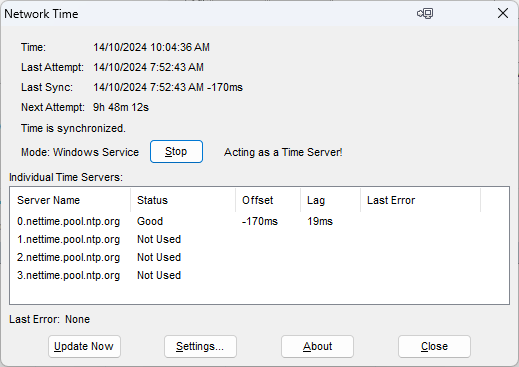 Its main attributes are:
- Free
- Open Source
- Small
- Easy to Install and Use
- And most importantly: Reliable
NetTime was originally written by Graham Mainwaring in 1997 with an open source release made in 1998. Graham made a number of updates to the program until he lost interest and finally abandoned the project officially on the 1st of July 2004.
The NetTime project has been resurrected by myself, Mark Griffiths, and I'm now making an updated version available here:
If you find NetTime useful, please consider making a donation to show your appreciation and to encourage further development of NetTime!
Download:
Version 3.14 - Current Stable Version:Version 3.20 Alpha 1 - Previous Test Version:
Version 3.20 Alpha 3 - Latest Test Version:
Previous versions as well as the source code can be downloaded from the SourceForge project page
Note: When upgrading from a previous version, you will need to shut down both the NetTime Service as well as the Tray Icon before running the installer. If you uninstall the old version first, you will need to restart your computer before starting the new installer.
Frequently Asked Questions (FAQs)
NetTime is failing to sync - it reports that all servers failed: The most common cause of this error is that a firewall is blocking the Network Time Protocol (UDP Port 123) between your system and the servers that NetTime is attempting to use. It's not always obvious that a firewall even exists as they generally allow regular web traffic to pass normally. If you have temporarily disabled all firewalls that you know of and continue to have this problem, then it's almost certainly a firewall that you aren't aware of. If you can run a UDP traceroute to port 123 on one of the time servers that you're using, that should give you an indication of where the firewall is located.
NetTime is failing to sync - it reports that it had "Inconsistent responses" If there is a large time difference between the local system and the time returned by the time server, NetTime will automatically check with a secondary server to ensure that the time that it has received is actually valid. If it can't find a unique secondary server that provides a time which is a close fit to the time returned by the primary server, it will fail with "Inconsistent Responses" The most common causes for this is if multiple servers are configured but point to the same IP address, or you're using the default servers and you are in a region with only 1 actual server in the NTP Pool. Possible solutions are to either remove all but one server address - in which case, the time returned by it will always be used - even if it's invalid, or change your servers - if you're using the NTP Pool servers, then you should point to the servers for a larger geographic area.
NetTime is syncing, but the time is out by an hour - e.g. Daylight savings time isn't be honoured correctly: NetTime works internally with UTC (Universal Time) and doesn't have any code for handling daylight savings or time zones. As long as Windows is configured correctly, it should automatically handle daylight savings changes for you. If Windows isn't handling it correctly, it most likely needs to be updated. You can also manually your time zone information using the free Microsoft tool: Windows Time Zone Editor tzedit.exe Alternatively, the Windows Server 2003 Resource Kit Tools reportedly includes a command line timezone.exe tool for advanced users.
I have configured NetTime to provide time to other systems, but it's not working: Ensure that the Windows Time Service is disabled along with any other NTP servers that may be running. Also, make sure that the Windows Firewall, and other firewalls, aren't bloicking the incoming connections to NetTime.
What does Offset mean? Offset is the time difference between the local system time and the time returned by the time server.
What does Lag mean? Lag is the amount of time that it took for the request from NetTime to go out to the server and for the response to come back. NetTime has code to try to compensate for high latency connections, but it won't work well on connections with asymmetric network delays - i.e. when the time that it takes for the request to go out is significantly different to the time for the response to come back.
Can I configure NetTime to use a proxy server? Unfortunately, the Network Time Protocol doesn't support the use of proxies, so that isn't an option and there isn't anything that I can do about this - sorry!
I have a problem not listed above: If NetTime isn't working correctly for you, please enable Debug level logging, attempt to do another time sync and then send an email to me with your log file attached along with a detailed description of the problem that you're having.
Configuration Notes:
Most settings should be fairly self explanatory, however some people have asked for clarification on certain settings:
Max Free Run: Indicates how long the program will run for without getting a valid sync before it considers the local time to no longer be accurate. Once this time period expires, the tray icon will change to a cross and if it's configured to act as a time server, it will stop responding to requests for the time.
If Time adjustment greater than: The default setting for this means that the local time will be updated regardless of how much difference there is between the current local time and the time reported by the remote server. There shouldn't normally be a reason to change this as the current version of NetTime will check with multiple servers to ensure that it isn't using an invalid time.
Always provide time: Enabling this option isn't recommended. Normally, NetTime will only provide time to other systems if it is configured to do so and it has successfully synced to an upstream server. If you enable the option to always provide time, you may find that it will give out invalid time to any systems that connect to it!
If you are using NetTime to act as a time server, you will need to disable the built in Time Service in Windows first. Although the description for the Windows Time Service indicates that disabling it may prevent other services from loading, I'm not currently aware of any such services that do actually require it. If you're not using NetTime as a time server, disabling the Windows Time Service is optional, but there shouldn't be any harm in disabling it to save a bit of RAM.
Notes for Administrators:
You can quickly install the client by running the above installer with either the /silent or /verysilent command line switches. If you want to preconfigure settings that are different to the defaults, they are stored in the registry under:
HKLM\Software\Subjective Software\NetTime
On 64 bit systems, the above location is remapped to:
HKLM\Software\Wow6432Node\Subjective Software\NetTime
Update History:
Version 3.20 Alpha 3:
- Fixed an initialization failure error
Version 3.20 Alpha 2:
- Improved Handling of Kiss of Death Packets
- Fixed handling of "unsynchronized" replies
- Improved reporting of errors when configured to act as a time server - e.g. if Windows Time Service is still running
- Reduced minimum retry period when not using NTP Pool Servers.
- Improved display of forms on systems with large fonts.
- If NetTime is running as a tray icon, starting the program again will show a message instructing the user to click on the tray icon.
- Fixed loading of log files containing null characters or with one or more lines without the normal crlf pair.
- Several improvements to handling of system suspend and resume.
- Fixed handling of "Max Free Run Time"
- If time sync fails, the program won't go straight to "Time Sync Lost" status until "Max Free Run Time" has elapsed - will now indicate "Time sync due" with an orange tray icon.
- Added description shown when viewing list of system services.
- Reworked IPC (Inter Process Communication) code to prevent crashes from occurring under certain circumstances.
- Log Viewer will now automatically update in real time when running as a service (would previously only update if not running as a service).
- Other minor changes and fixes
Version 3.20 Alpha 1:
- Added option to gradually correct small time errors instead of adjusting the time in one hit - thanks to code provided by Julien Blitte
- Added log file rotation - also thanks to Julien Blitte.
- Fixed a problem with high CPU usage when a lot of logging activity taking place.
- A few other minor improvements.
Version 3.14:
- Improved compatibility with other NTP/SNTP clients when NetTime is acting as a server - e.g. Windows built in time client.
- Added extra logging information.
- Fixed an error which could sometimes occur when installing over the top of a previous version.
- Fixed a problem preventing full uninstallation under certain circumstances.
- Removed requirement to manually shut down NetTime before installing a new version. (Windows restart may be required sometimes due to above bug)
- Improved handling when service is disabled & UAC disabled.
- Added code to re-show tray icon after Windows Explorer crashes.
- A few other minor improvements.
Version 3.13:
- Fixed an error that caused the program to always check for updates when run as a limited user.
Version 3.12:
- Fixed an Access Violation error.
Version 3.11:
- Added a workaround for a VCL bug which could prevent the NetTime service from being installed properly in very rare circumstances.
Version 3.1:
- Fixed a problem with running on Windows NT4.
- Added a balloon tip to the tray icon when run after installation to indicate that NetTime is running.
- When set to not change time on large adjustment, will now ask user when doing a manual check.
- Some changes to improve compatibility with newer versions of Delphi - notes added about upgrading to newer version of the Internet Component Suite.
- Added option to always provide time when acting as a server.
Version 3.0:
- Version Number Change only
Version 3.0 Release Candidate 1:
- No significant changes since Beta 4
Version 3.0 Beta 4:
- Fixed a few more bugs introduced with Beta 2
Version 3.0 Beta 3:
- Fixed a few bugs introduced with Beta 2
Version 3.0 Beta 2:
- Added capability to automatically check for new versions
- Added button to view log within NetTime
- Intervals can now be entered with units instead of only as a number of seconds
- Added support for Windows Themes
- Added option to quit if time adjustment is larger than a set value
- Added command line option to sync only once and then exit (/updateonce)
- Added command line option to only attempt syncing once and exit regardless of success (/tryonce)
Version 3.0 Beta 1:
- Various UI fixes and improvements
- Added default servers - thanks to the NTP Pool Project
- Added support for the Network Time Protocol "Kiss of Death" packet
- Added automatic syncing on additional triggers - e.g. resuming from suspend, time jumping forward or backwards
- Added logging capability
- Added extra information to the UI to show more details such as the time to the next sync, adjustment for the last sync and offsets and lag for each server queried
- Changed server query method to minimize server loads - it now queries only a single server, unless it finds a time difference of greater than 10 seconds, in which case it will check with an alternate server to ensure that an invalid time isn't used
- Improved handling of UAC - User Account Control - under Windows Vista & 7
- Dropped Windows 95 pseudo service - Can still be used under Windows 98/98/Me as a regular application however
- Removed automatic configuration screens for searching for available servers - not needed with the NTP Pool default servers
- Fixed several UI problems
- Fixed problems with running the client under limited user accounts in conjunction with the NetTime Windows Service
- Various other minor fixes and improvements
Despite the amount of work that has gone into this updated version, most of the credit for it still lies with Graham Mainwaring.
Source Notes:
The latest version of NetTime was compiled and tested with Borland Delphi 7 Professional. Earlier versions have also been tested to compile successfully with the Personal Edition of Delphi 7 - if you would like to get into Delphi and make changes to NetTime, you might be able to still find a copy of Delphi 7 Personal Edition that you can download if you do enough searching. Alternatively, you can try using the latest trial version of Delphi available from Embarcadero.The latest version has been tested with Delphi XE2 Professional: The current version includes an older version of the Internet Component Suite which is not compatible with Unicode versions of Delphi (i.e. Delphi 2009 and newer) Upgrading to the latest version of the Internet Component Suite by François Piette will resolve the Unicode issues. When upgrading to the new version of the Internet Component Suite, you will need to change the reference to HttpProt in the uses clause of UpdateCheck.pas to read OverbyteIcsHttpProt.
Contact me:
If you discover any problems with this version or would like to make a suggestion, please contact me:Of course, as this is free software, I can't give any guarantees as to when (or even if) any feature requests will be incorporated into a future version - unless you're wanting to pay for it of course! If you have a programming project that you would like me to work on for you, you're certainly more than welcome to contact me!
Accuracy Notes:
NetTime, like most SNTP clients, will generally sync your system time to within 100 milliseconds of the correct time - often within 10 milliseconds. Of course, the accuracy is highly dependent on the accuracy of the server that it is connecting to - This updated version of NetTime has improvements included to try to ensure that even a badly inaccurate time server won't put the system time out - more information about this is included under History & Other Notes at the bottom. Asymmetric latency (Network delay which takes longer one way than the other) can also have an adverse impact on time accuracy.SNTP clients resync the system time at regular intervals - between these time syncs, the system will be allowed to run at its normal speed which may mean that it runs either fast or slow - gradually putting the system time out until the next sync takes place. The speed at which the system time deviates from the correct time depends greatly on the system hardware and also to a certain extent what software is being run. Most PCs gain or lose a few seconds each day, however I've seen a system that loses 9 seconds per hour - more than 3.5 minutes per day!
The vast majority of users should find that NetTime more than meets their needs, however if you have specific requirements for very accurate time, I recommend that you investigate installing a full NTP client. Although you can set NetTime to sync more frequently to compensate for an inaccurate system clock, this isn't really recommended because of the greater strain that it puts onto the public NTP servers. A full NTP client has extra features to ensure better time accuracy (normally well below 10 milliseconds even between time syncs) by adjusting the rate that the system clock runs at. If you are administering a large number of PCs for an organization, it's also recommended that you configure a full NTP client on your network and have the rest of your systems sync to it with an SNTP client - this reduces the load on the public time servers even further as well as ensuring that all systems are in sync with a single time source.
History & Other Notes:
Part of the apparent reason why Graham abandoned the NetTime project was because Windows 2000 and XP already include an SNTP Client and a free download was available from Microsoft for Windows NT. Graham characterized the Microsoft NTP client as being full featured, however, I strongly disagree with this - I would call the Windows SNTP client very basic - the user interface has only 2 features - allowing the SNTP server to be changed and a button to attempt an immediate sync. The Microsoft SNTP client does have more features available, but they require manual editing of the system registry - something which most users are understandably reluctant to do. In the end, even with editing the registry settings, the Microsoft client is still just an SNTP client with the limitation of being able to sync with only a single remote server.
Like the vast majority of SNTP clients that can only sync with one server, (and also most of the remainder that only have backups for if the primary server fails completely) the Microsoft SNTP client has a major problem when it receives a reply with a vastly different time to what is currently set on the system - the software simply has no way to know which is closer to being correct - either the system time could be wildly inaccurate (e.g. because the CMOS battery has failed) or the answer from the server could be wrong (either accidentally or maliciously.)
For Windows XP, in order to prevent the Microsoft SNTP client from setting the system time to a wildly incorrect value, Microsoft made the design decision that their client would only update the system time if the server response was within 15 hours of the current system time. This reduced the risk of an invalid time being set on the system (but not completely) but also has the effect that if the system time isn't at least reasonably accurate it never would be until manually fixed! For a system with a failed CMOS battery, the Microsoft SNTP client is pretty much useless.
For Windows Vista (and 7) Microsoft relaxed the rules so that (at least when manually triggering an update) the current system time being wrong doesn't prevent the SNTP client from updating the system time. This of course does mean that an incorrect response from the time server can put the system time way out. The Windows Time Service in Windows 7 is also configured by default to not start automatically each time the system is started - the user interface reports that Windows is configured to automatically update the system time, but it doesn't unless the user manually starts the Windows Time Service either through the Services Control Panel applet, or by requesting a manual sync. Unless the user reconfigures the Windows Time Service to start automatically, it will be effectively disabled every time the system is restarted!
NetTime ensures that it is not setting the system time to an incorrect value by always checking with a second server (when configured) if the time adjustment is more than 10 seconds. Short of a major bug in the program design or a very sustained attempt to maliciously skew the system time by a rogue time server, NetTime simply won't set an invalid system time!
Links:
You might also be interested in:FlexiRoster - Flexible Rostering Software
UltraSmartCharger - Open Source Charger/Analyzer for NiMH/NiCd/NiZn Batteries
GPing - Graphical Ping
POP3Filter - An Advanced Bayesian Spam Filter
JpegDec: Open Source Fast JPEG Decoder for Delphi
What’s New in the Aone Software - OS Non-Proxy Atomic Sync 2?
Screen Shot

System Requirements for Aone Software - OS Non-Proxy Atomic Sync 2
- First, download the Aone Software - OS Non-Proxy Atomic Sync 2
-
You can download its setup from given links:

Aone Software - OS Non-Proxy Atomic Sync 2 & Kali Software Crack

Aone Software - OS Non-Proxy Atomic Sync 2& Software

Aone Software - OS Non-Proxy Atomic Sync 2
About Author
