
Soldier of Fordune *German - English* (null) serial key or number

Soldier of Fordune *German - English* (null) serial key or number
Dreyfus affair
The Dreyfus Affair (French: l'affaire Dreyfus, pronounced [lafɛːʁ dʁɛfys]) was a political scandal that divided the Third French Republic from 1894 until its resolution in 1906. "L'Affaire", as it is known in French, has come to symbolise modern injustice in the Francophone world,[1] and it remains one of the most notable examples of a complex miscarriage of justice and antisemitism. The role played by the press and public opinion proved influential in the conflict.
The scandal began in December 1894 when Captain Alfred Dreyfus was convicted of treason. Dreyfus was a 35-year-old Alsatian French artillery officer of Jewish descent. He was sentenced to life imprisonment for allegedly communicating French military secrets to the German Embassy in Paris, and was imprisoned in Devil's Island in French Guiana, where he spent nearly five years.
In 1896, evidence came to light—primarily through an investigation instigated by Georges Picquart, head of counter-espionage—which identified the real culprit as a French Army major named Ferdinand Walsin Esterhazy. When high-ranking military officials suppressed the new evidence, a military court unanimously acquitted Esterhazy after a trial lasting only two days. The Army laid additional charges against Dreyfus, based on forged documents. Subsequently, Émile Zola's open letterJ'Accuse…!, stoked a growing movement of support for Dreyfus, putting pressure on the government to reopen the case.
In 1899, Dreyfus was returned to France for another trial. The intense political and judicial scandal that ensued divided French society between those who supported Dreyfus (now called "Dreyfusards"), such as Sarah Bernhardt, Anatole France, Henri Poincaré and Georges Clemenceau, and those who condemned him (the anti-Dreyfusards), such as Édouard Drumont, the director and publisher of the antisemitic newspaper La Libre Parole. The new trial resulted in another conviction and a 10-year sentence, but Dreyfus was pardoned and released. In 1906, Dreyfus was exonerated and reinstated as a major in the French Army. He served during the whole of World War I, ending his service with the rank of lieutenant-colonel. He died in 1935.
The affair from 1894 to 1906 divided France into pro-republican, anticlerical Dreyfusards and pro-Army, mostly Catholic "anti-Dreyfusards". It embittered French politics and encouraged radicalisation.[2]
Summary[edit]
At the end of 1894 a French army captain named Alfred Dreyfus, a graduate of the École Polytechnique and a Jew of Alsatian origin, was accused of handing secret documents to the Imperial German military. After a closed trial, he was found guilty of treason and sentenced to life imprisonment. He was deported to Devil's Island. At that time, the opinion of the French political class was unanimously unfavourable towards Dreyfus.
The Dreyfus family, particularly his brother Mathieu, remained convinced of his innocence and worked with the journalist Bernard Lazare to prove it. In March 1896, Colonel Georges Picquart, head of counter-espionage, found evidence that the real traitor was Major Ferdinand Walsin Esterhazy. The General Staff, however, refused to reconsider its judgment and transferred Picquart to North Africa.
In July 1897 Dreyfus’s family contacted the President of the Senate Auguste Scheurer-Kestner to draw attention to the tenuousness of the evidence against Dreyfus. Scheurer-Kestner reported three months later that he was convinced Dreyfus was innocent, and persuaded Georges Clemenceau, a newspaper reporter and former member of the Chamber of Deputies. In the same month, Mathieu Dreyfus made a complaint about Esterhazy to the Ministry of War. In January 1898 two events raised the case to national prominence: Esterhazy was acquitted of treason charges (subsequently shaving his moustache and fleeing France), and Émile Zola published his "J'accuse...!" a Dreyfusard declaration that rallied many intellectuals to Dreyfus' cause. France became increasingly divided over the case, and the issue continued to be hotly debated until the end of the century. Antisemitic riots erupted in more than twenty French cities and there were several deaths in Algiers.
Despite covert attempts by the army to quash the case, the initial conviction was annulled by the Supreme Court after a thorough investigation. A new court-martial was held at Rennes in 1899. Dreyfus was convicted again and sentenced to ten years of hard labour, though the sentence was commuted due to extenuating circumstances. Dreyfus accepted the presidential pardon granted by President Émile Loubet. In 1906 his innocence was officially established by an irrevocable judgement of the Supreme Court.[3] Dreyfus was reinstated in the army with the rank of Major and participated in the First World War. He died in 1935.
The implications of this case were numerous and affected all aspects of French public life. It was regarded as a vindication of the Third Republic (and became a founding myth)[4], but it led to a renewal of nationalism in the military. It slowed the reform of French Catholicism and republican integration of Catholics. It was during The Affair that the term intellectual was coined. The Affair engendered numerous antisemitic demonstrations, which in turn affected sentiment within the Jewish communities of Central and Western Europe. This persuaded Theodor Herzl, one of the founding fathers of Zionism that the Jews must leave Europe and establish their own state.
Contexts[edit]
Political[edit]
In 1894, the Third Republic was twenty-four years old. Although the 16 May Crisis in 1877 had crippled the political influence of both the Bourbon and Orléanistroyalists, its ministries continued to be short-lived as the country lurched from crisis to crisis: three immediately preceding the Dreyfus Affair were the near-coup of Georges Boulanger in 1889, the Panama scandal in 1892, and the anarchist threat (reduced by the "villainous laws" of July 1894). The elections of 1893 were focused on the "social question" and resulted in a Republican victory (just under half the seats) against the conservative right and the reinforcement of the Radicals (about 150 seats) and Socialists (about 50 seats).
The opposition of the Radicals and Socialists resulted in a centrist government with policies oriented towards economic protectionism, a certain indifference to social issues, a willingness to break international isolation, the Russian alliance, and development of the colonial empire. These centrist policies resulted in cabinet instability, with some Republican members of the government sometimes aligning with the radicals and some Orléanists aligning with the Legitimists in five successive governments from 1893 to 1896. This instability coincided with an equally unstable presidency: President Sadi Carnot was assassinated on 24 June 1894, his moderate successor Jean Casimir-Perier resigned on 15 January 1895 and was replaced by Félix Faure.
Following the failure of the radical government of Léon Bourgeois in 1896, the president appointed Jules Méline as prime minister. His government faced the opposition of the left and of some Republicans (including the Progressive Union) and made sure to keep the support of the right. He sought to appease religious, social, and economic tensions and conducted a fairly conservative policy. He succeeded in improving stability, and it was under this stable government that the Dreyfus Affair occurred.[5]
Military[edit]
The Dreyfus Affair occurred in the context of the annexation of Alsace and Moselle by the Germans, an event that fed the most extreme nationalism. The traumatic defeat in 1870 seemed far away, but a vengeful spirit remained. Many participants in the Dreyfus Affair were Alsatian.[Note 1]
The military required considerable resources to prepare for the next conflict, and it was in this spirit that the Franco-Russian Alliance, which some saw as "against nature",[Note 2] of 27 August 1892 was signed. The army had recovered from the defeat but many of its officers were aristocrats and monarchists. Cult of the flag and contempt for the parliamentary republic prevailed in the army.[6] The Republic celebrated its army; the army ignored the Republic.
Over the previous ten years the army had experienced a significant shift in its twofold aim to democratize and modernize. The graduates of the École Polytechnique competed effectively with officers from the main career path of Saint-Cyr, which caused strife, bitterness, and jealousy among junior officers expecting promotions. The period was also marked by an arms race that primarily affected artillery. There were improvements in heavy artillery (guns of 120 mm and 155 mm, Models 1890 Baquet, new hydropneumatic brakes), but also and especially the development of the ultra-secret 75mm gun.[7]
The operation of military counterintelligence, alias the "Statistics Section" (SR), should be noted. Spying as a tool for secret war was a novelty as an organised activity in the late 19th century. The Statistics Section was created in 1871 but consisted of only a handful of officers and civilians. Its head in 1894 was Lieutenant-Colonel Jean Sandherr, a graduate of Saint-Cyr, an Alsatian from Mulhouse, and a convinced anti-Semite. Its military mission was clear: to retrieve information about potential enemies of France and to feed them false information. The Statistics Section was supported by the "Secret Affairs" of the Quai d'Orsay at the Ministry of Foreign Affairs, which was headed by a young diplomat, Maurice Paléologue. The arms race created an acute atmosphere of intrigue in French counter-espionage from 1890. One of the missions of the section was to spy on the German Embassy at Rue de Lille in Paris to thwart any attempt to transmit important information to the Germans. This was especially critical since several cases of espionage had already hit the headlines of newspapers, which were fond of sensationalism. Thus in 1890 the archivist Boutonnet was convicted for selling plans of shells that used melinite.[citation needed]
The German military attaché in Paris in 1894 was Count Maximilian von Schwartzkoppen, who developed a policy of infiltration which appears to have been effective. In the 1880s Schwartzkoppen had begun an affair with an Italian military attache, Lieutenant Colonel Count Alessandro Panizzardi.[8] While neither had anything to do with Dreyfus, their intimate and erotic correspondence (e.g. "Don't exhaust yourself with too much buggery."),[9] which was obtained by the authorities, lent an air of truth to other documents that were forged by prosecutors to lend retroactive credibility to Dreyfus's conviction as a spy. Some of these forgeries even referenced the real affair between the two officers; in one, Alessandro supposedly informed his lover that if "Dreyfus is brought in for questioning", they must both claim that they "never had any dealings with that Jew. ... Clearly, no one can ever know what happened with him."[10] The letters, real and fake, provided a convenient excuse for placing the entire Dreyfus dossier under seal, given that exposure of the liaison would have 'dishonoured' Germany and Italy's military and compromised diplomatic relations. As homosexuality was, like Judaism, then often perceived as a sign of national degeneration, recent historians have suggested that combining them to inflate the scandal may have shaped the prosecution strategy.[11][12]
Since early 1894, the Statistics Section had investigated traffic in master plans for Nice and the Meuse conducted by an officer whom the Germans and Italians nicknamed Dubois.[Note 3] This is what led to the origins of the Dreyfus Affair.
Social[edit]
The social context was marked by the rise of nationalism and of antisemitism.
The growth of antisemitism, virulent since the publication of Jewish France by Édouard Drumont in 1886 (150,000 copies in the first year), went hand in hand with the rise of clericalism. Tensions were high in all strata of society, fueled by an influential press, which was virtually free to write and disseminate any information even if offensive or defamatory. Legal risks were limited if the target was a private person.
Antisemitism did not spare the military, which practiced hidden discrimination with the "cote d'amour" (a subjective assessment of personal acceptability) system of irrational grading, encountered by Dreyfus in his application to the Bourges School.[13] However, while prejudices of this nature undoubtedly existed within the confines of the General Staff, the French Army as a whole was relatively open to individual talent. At the time of the Dreyfus Affair there were an estimated 300 Jewish officers in the army (about 3 per cent of the total), of whom ten were generals.[14]
The popularity of the duel using sword or small pistol, sometimes causing death, bore witness to the tensions of the period. When a series of press articles in La Libre Parole[15] accused Jewish officers of "betraying their birth", the officers challenged the editors. Captain Crémieu-Foa, a Jewish Alsatian graduated from the Ecole Polytechnique, fought unsuccessfully against Drumont[Note 4][16] and against M. de Lamase, who was the author of the articles. Captain Mayer, another Jewish officer, was killed by the Marquis de Morès, a friend of Drumont, in another duel.
Hatred of Jews was now public and violent, driven by a firebrand (Drumont) who demonized the Jewish presence in France. Jews in metropolitan France in 1895 numbered about 80,000 (40,000 in Paris alone), who were highly integrated into society; an additional 45,000 Jews lived in Algeria. The launch of La Libre Parole with a circulation estimated at 200,000 copies in 1892,[17] allowed Drumont to expand his audience to a popular readership already enticed by the boulangiste adventure in the past. The antisemitism circulated by La Libre Parole, as well as by L’Éclair, Le Petit Journal, La Patrie, L'Intransigeant and La Croix, drew on antisemitic roots in certain Catholic circles.[18]
Origins of the case and the trial of 1894[edit]
The beginning: Acts of espionage[edit]

The origin of the Dreyfus Affair, although fully clarified since the 1960s,[19] has aroused much controversy for nearly a century. The intentions remain unclear.[Note 5] Many eminent historians express different hypotheses about the affair[Note 6] but all arrive at the same conclusion: Dreyfus was innocent of any crime or offence.
Discovery of the Bordereau[edit]
The staff of the Military Intelligence Service (SR) worked around the clock [20] to spy on the German Embassy in Paris. They had managed to hire a French housekeeper named "Madame Bastian" who worked in the building to help in this effort and in September 1894 she found a torn-up note[21] which she handed over to her employers at the Military Intelligence Service. This note later became known as "the bordereau".[Note 7] This piece of paper, torn into six large pieces,[22] unsigned and undated, was addressed to the German military attaché stationed at the German Embassy, Max von Schwartzkoppen. It stated that confidential French military documents regarding the newly developed "hydraulic brake of 120, and the way this gun has worked"[23][24] were about to be sent to a foreign power.
The search for the author of the bordereau[edit]

This catch seemed of sufficient importance for the head of the "Statistical Section",[25] the Mulhousian[26]Jean Sandherr, to inform the Minister of War, GeneralAuguste Mercier. In fact the SR suspected that there had been leaks since the beginning of 1894 and had been trying to find the perpetrator. The minister had been harshly attacked in the press for his actions, which were deemed incompetent,[27] and appears to have sought an opportunity to enhance his image.[28][29] He immediately initiated two secret investigations, one administrative and one judicial. To find the culprit, using simple though crude reasoning,[30] the circle of the search was arbitrarily restricted to suspects posted to, or former employees of, the General Staff – necessarily a trainee artillery[Note 8] officer.[Note 9]
The ideal culprit was identified: Captain Alfred Dreyfus, a graduate of the École polytechnique and an artillery officer, of the Jewish faith and of Alsatian origin, coming from the republican meritocracy.[31] At the beginning of the case the emphasis was rather on the Alsatian origins of Dreyfus than on his religion. These origins were not, however, exceptional because these officers were favoured by France for their knowledge of the German language and culture.[32][33] There was also antisemitism in the offices of the General Staff,[34] and it fast became central to the affair by filling in the credibility gaps in the preliminary enquiry.[30] In particular, Dreyfus was at that time the only Jewish officer to be recently passed by the General Staff.
In fact, the reputation[35] of Dreyfus as a cold and withdrawn or even haughty character, as well as his "curiosity", worked strongly against him. These traits of character, some false, others natural, made the charges plausible by turning the most ordinary acts of everyday life in the ministry into proof of espionage. From the beginning a biased and one-sided multiplication of errors led the State to a false position. This was present throughout the affair, where irrationality prevailed over the positivism in vogue in that period:[36]
From this first hour the phenomenon occurred that will dominate the whole affair. It is no longer controlled by facts and circumstances carefully examined which will constitute a belief; it is the irresistible cavalier conviction which distorts the facts and beliefs.
Expertise in writing[edit]
To condemn Dreyfus, the writing on the bordereau had to be compared to that of the Captain. There was nobody competent to analyse the writing on the General Staff.[37] Then Major du Paty de Clam[38][39] entered the scene: an eccentric man who prided himself on being an expert in graphology. On being shown some letters by Dreyfus and the bordereau on 5 October, du Paty concluded immediately who had written the two writings. After a day of additional work he provided a report that, despite some differences, the similarities were sufficient to warrant an investigation. Dreyfus was therefore "the probable author" of the bordereau in the eyes of the General Staff.[40]

General Mercier believed he had the guilty party, but he exaggerated the value of the affair, which took on the status of an affair of state during the week preceding the arrest of Dreyfus. The Minister did consult and inform all the authorities of the State,[41] yet despite prudent counsel[Note 10] and courageous objections expressed by Gabriel Hanotaux in the Council of Ministers[42] he decided to pursue it.[43] Du Paty de Clam was appointed Judicial Police Officer to lead an official investigation.
Meanwhile several parallel sources of information were opening up, some on the personality of Dreyfus, others to ensure the truth of the identity of the author of the bordereau. The expert[Note 11] Gobert was not convinced and found many differences. He even wrote that "the nature of the writing on the bordereau excludes disguised handwriting".[44] Disappointed, Mercier then called in Alphonse Bertillon, the inventor of forensic anthropometry but no handwriting expert. He was initially no more positive than Gobert but he did not exclude the possibility of its being the writing of Dreyfus.[45] Later, under pressure from the military,[46] he argued that Dreyfus had autocopied it and developed his theory of "autoforgery".
The arrest[edit]
On 13 October 1894, without any tangible evidence and with an empty file, General Mercier summoned Captain Dreyfus for a general inspection in "bourgeois clothing", i.e. in civilian clothes. The purpose of the General Staff was to obtain the perfect proof under French law: a confession. That confession was to be obtained by surprise – by dictating a letter based on the bordereau[47][48] to reveal his guilt.
In the morning of 15 October 1894 Captain Dreyfus underwent this ordeal but admitted nothing. Du Paty even tried to suggest suicide by placing a revolver in front of Dreyfus, but he refused to take his life, saying he "wanted to live to establish his innocence". The hopes of the military were crushed. Nevertheless Du Paty de Clam still arrested the captain,[49] accused him of conspiring with the enemy, and told him that he would be brought before a court-martial. Dreyfus was imprisoned at the Cherche-Midi prison in Paris.[50]
The enquiry and the first military court[edit]
Mrs. Dreyfus was informed of the arrest the same day by a police raid to search their apartment. She was terrorized by Du Paty, who ordered her to keep the arrest of her husband secret and even said, "One word, one single word and it will be a European war!"[51] Totally illegally,[52] Dreyfus was placed in solitary confinement in prison, where Du Paty interrogated him day and night in order to obtain a confession, which failed. The captain was morally supported by the first Dreyfusard, Major Forzinetti, commandant of the military prisons of Paris.
On 29 October 1894, the affair was revealed in an article in La Libre Parole, the antisemitic newspaper owned by Édouard Drumont. This marked the beginning of a very brutal press campaign until the trial. This event put the affair in the field of antisemitism where it remained until its conclusion.[53]
On 1 November 1894, Alfred's brother, Mathieu Dreyfus, became aware of the arrest after being called urgently to Paris. He became the architect of the arduous fight for the liberation of his brother.[54] Without hesitation, he began looking for a lawyer, and retained the distinguished criminal lawyer Edgar Demange.[55]
The enquiry[edit]
On 3 November 1894, General Saussier, the Military governor of Paris, reluctantly[56] gave the order for an enquiry. He had the power to stop the process but did not, perhaps because of an exaggerated confidence in military justice.[57] Major Besson d'Ormescheville, the recorder for the Military Court, wrote an indictment in which "moral elements" of the charge (which gossiped about the habits of Dreyfus and his alleged attendance at "gambling circles", his knowledge of German,[Note 12] and his "remarkable memory") were developed more extensively than the "material elements",[Note 13] which are rarely seen in the charge:
"This is a proof of guilt because Dreyfus made everything disappear".
The complete lack of neutrality of the indictment led to Émile Zola calling it a "monument of bias".[58]
On 4 December 1894, Dreyfus was referred to the first Military Court with this dossier. The secrecy was lifted and Demange could access the file for the first time. After reading it the lawyer had absolute confidence, as he saw the emptiness of the prosecution's case.[59] The prosecution rested completely on the writing on a single piece of paper, the bordereau, on which experts disagreed, and on vague indirect testimonies.
The trial: "Closed Court or War!"[edit]

During the two months before the trial, the press went wild. La Libre Parole, L'Autorité, Le Journal, and Le Temps described the supposed life of Dreyfus through lies and bad fiction.[60] This was also an opportunity for extreme headlines from La Libre Parole and La Croix to justify their previous campaigns against the presence of Jews in the army on the theme "You have been told!"[61] This long delay above all enabled the General Staff to prepare public opinion and to put indirect pressure on the judges.[62] On 8 November 1894, General Mercier declared Dreyfus guilty in an interview with Le Figaro.[63] He repeated himself on 29 November 1894 in an article by Arthur Meyer in Le Gaulois, which in fact condemned the indictment against Dreyfus and asked, "How much freedom will the military court have to judge the defendant?"[64]
The jousting of the columnists took place within a broader debate about the issue of a closed court. For Ranc and Cassagnac, who represented the majority of the press, the closed court was a low manoeuvre to enable the acquittal of Dreyfus, "because the minister is a coward". The proof was "that he grovels before the Prussians" by agreeing to publish the denials of the German ambassador in Paris.[65] In other newspapers, such as L’Éclair on 13 December 1894: "the closed court is necessary to avoid a casus belli"; while for Judet in Le Petit Journal of 18 December: "the closed court is our impregnable refuge against Germany"; or in La Croix the same day: it must be "the most absolute closed court".[66]
The trial opened on 19 December 1894 at one o'clock[67] and a closed court was immediately pronounced.[Note 14] This closed court was not legally consistent since Major Picquart and Prefect Louis Lépine were present at certain proceedings in violation of the law. The closed court allowed the military to still not disclose the emptiness of their evidence to the public and to stifle debate.[68][69] As expected, the emptiness of their case appeared clearly during the hearings. Detailed discussions on the bordereau showed that Captain Dreyfus could not be the author.[70][71] At the same time the accused himself protested his innocence and defended himself point by point with energy and logic.[72] Moreover, his statements were supported by a dozen defence witnesses. Finally, the absence of motive for the crime was a serious thorn in the prosecution case. Dreyfus was indeed a very patriotic officer highly rated by his superiors, very rich and with no tangible reason to betray France.[73] The fact of Dreyfus's Jewishness was used only by the right-wing press and was not presented in court.
Alphonse Bertillon, who was not an expert in handwriting, was presented as a scholar of the first importance. He advanced the theory of "autoforgery" during the trial and accused Dreyfus of imitating his own handwriting, explaining the differences in writing by using extracts of writing from his brother Matthieu and his wife Lucie. This theory, although later regarded as bizarre and astonishing, seems to have had some effect on the judges.[74] In addition, Major Hubert-Joseph Henry made a theatrical statement in open court.[Note 15][75] He argued that leaks betraying the General Staff had been suspected to exist since February 1894 and that "a respectable person" accused Captain Dreyfus. He swore on oath that the traitor was Dreyfus, pointing to the crucifix hanging on the wall of the court.[76] Dreyfus was apoplectic with rage and demanded to be confronted with his anonymous accuser, which was rejected by the General Staff. The incident had an undeniable effect on the court, which was composed of seven officers who were both judges and jury. However, the outcome of the trial remained uncertain. The conviction of the judges had been shaken by the firm and logical answers of the accused.[77] The judges took leave to deliberate, but the General Staff still had a card in hand to tip the balance decisively against Dreyfus.
Transmission of a secret dossier to the judges[edit]
Military witnesses at the trial alerted high command about the risk of acquittal. For this eventuality the Statistics Section had prepared a file containing, in principle, four "absolute" proofs of the guilt of Captain Dreyfus accompanied by an explanatory note. The contents of this secret file remained uncertain until 2013, when they were released by the French Ministry of Defence.[78][79] Recent research indicates the existence of numbering which suggests the presence of a dozen documents. Among these letters were some of an erotic homosexual nature (the Davignon letter among others) raising the question of the tainted methods of the Statistics Section and the objective of their choice of documents.[80]
The secret file was illegally submitted at the beginning of the deliberations by the President of the Military Court, Colonel Émilien Maurel, by order of the Minister of War, General Mercier.[81] Later at the Rennes trial of 1899, General Mercier explained the nature of the prohibited disclosure of the documents submitted in the courtroom.[Note 16] This file contained, in addition to letters without much interest, some of which were falsified, a piece known as the "Scoundrel D ...".[82]
It was a letter from the German military attache, Max von Schwarzkoppen, to the Italian military attaché, Alessandro Panizzardi, intercepted by the SR. The letter was supposed to accuse Dreyfus definitively since, according to his accusers, it was signed with the initial of his name.[83] In reality, the Statistics Section knew that the letter could not be attributed to Dreyfus and if it was, it was with criminal intent.[84] Colonel Maurel confirmed in the second Dreyfus trial that the secret documents were not used to win the support of the judges of the Military Court. He contradicted himself, however, by saying that he read only one document, "which was enough".[85]
Conviction, degradation, and deportation[edit]
On 22 December 1894, after several hours of deliberation, the verdict was reached. Seven judges unanimously convicted Alfred Dreyfus of collusion with a foreign power, to the maximum penalty under section 76 of the Criminal Code: permanent exile in a walled fortification (prison), the cancellation of his army rank and military degradation. Dreyfus was not sentenced to death, as it had been abolished for political crimessince 1848.
For the authorities, the press and the public, doubts had been dispelled by the trial and his guilt was certain. Right and left regretted the abolition of the death penalty for such a crime. Antisemitism peaked in the press and occurred in areas so far spared.[87]Jean Jaurès regretted the lightness of the sentence in an address to the House and wrote, "A soldier has been sentenced to death and executed for throwing a button in the face of his corporal. So why leave this miserable traitor alive?" Clemenceau in Justice made a similar comment.[88]
On 5 January 1895, the ceremony of degradation took place in the Morlan Court of the Military School in Paris. While the drums rolled, Dreyfus was accompanied by four artillery officers, who brought him before an officer of the state who read the judgment. A Republican Guard adjutant tore off his badges, thin strips of gold, his stripes, cuffs and sleeves of his jacket. Witnesses report the dignity of Dreyfus, who continued to maintain his innocence while raising his arms: "Innocent, Innocent! Vive la France! Long live the Army". The Adjutant broke his sword on his knee and then the condemned Dreyfus marched at a slow pace in front of his former companions.[89] An event known as "the legend of the confession" took place before the degradation. In the van that brought him to the military school, Dreyfus is said to have confided his treachery to Captain Lebrun-Renault.[90][91] It appears that this was merely self-promotion by the captain of the Republican Guard, and that in reality Dreyfus had made no admission. Due to the affair's being related to national security, the prisoner was then held in solitary confinement in a cell awaiting transfer. On 17 January 1895, he was transferred to the prison on Île de Ré where he was held for over a month. He had the right to see his wife twice a week in a long room, each of them at one end, with the director of the prison in the middle.[92]
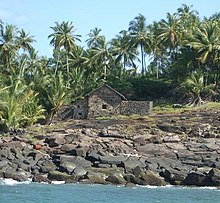
At the last minute, at the initiative of General Mercier, a law was passed on 9 February 1895, restoring the Îles du Salut in French Guiana
Dolph Lundgren
 | |
| Born | (1957-11-03) 3 November 1957 (age 62) |
|---|---|
| Education | University of Sydney (M.Sc) Royal Institute of Technology (B.Sc) |
| Occupation |
|
| Years active | 1978–present |
| Spouse(s) | (m. 1994; div. 2011) |
| Children | 2 |
| Website | dolphlundgren.com |
Hans Dolph Lundgren (born 3 November 1957),[1] better known as Dolph Lundgren (/ˈlʌndɡrən/, Swedish: [ˈdɔlːf ˈlɵ̌nːdɡreːn] ( listen)), is a Swedish actor, filmmaker, and martial artist. Lundgren's breakthrough came in 1985, when he starred in Rocky IV as the imposing Soviet Union boxer Ivan Drago. Since then, he has starred in more than 70 films, almost all of them in the action genre.
Lundgren received a degree in chemical engineering from the Royal Institute of Technology in the early 1980s and a master's degree in chemical engineering from the University of Sydney in 1982. He holds the rank of 4th danblack belt in Kyokushin karate and was European champion in 1980–81. While in Sydney, he became a bodyguard for Jamaican singer Grace Jones and began a relationship with her. He received a Fulbright scholarship to MIT and moved to Boston. Jones convinced him to leave the university and move to New York City to be with her and begin acting, where, after a short stint as a model and bouncer at the Manhattan nightclub The Limelight, Lundgren got a small debut role as a KGB henchman in the James Bond film A View to a Kill.
After appearing in Rocky IV, Lundgren portrayed He-Man in the 1987 science fantasy film Masters of the Universe, Lt. Rachenko in Red Scorpion (1988) and Frank Castle in the 1989 film The Punisher. Throughout the 1990s he appeared in films such as I Come in Peace (1990), Cover-Up (1991), Showdown in Little Tokyo (1991), Universal Soldier film series (1992, 2009, 2012), Joshua Tree (1993), Pentathlon (1994), Men of War (1994), Johnny Mnemonic (1995), The Shooter (1995), Silent Trigger (1996), The Peacekeeper (1997), and Blackjack (1998). In 2004 he directed his first film, The Defender, and subsequently directed The Mechanik (2005), Missionary Man (2007), Command Performance (2009), and Icarus (2010), also starring in all of them.
After a long spell performing in direct-to-video films since 1995, Lundgren returned to Hollywood in 2010 with the role of Gunnar Jensen in The Expendables, alongside Sylvester Stallone and an all-action star cast. He reprised his role in The Expendables 2 (2012) and The Expendables 3 (2014). Also in 2014, he co-starred in Skin Trade, an action thriller about human trafficking he co-wrote and produced. The film marks his third collaboration with Cary-Hiroyuki Tagawa, the previous two being Showdown in Little Tokyo (1991) and Bridge of Dragons (1999). He reprised his role of Ivan Drago in Creed II (2018), and is due to reprise his role as Gunner Jensen in The Expendables 4 (2020).[2][3] He appears in Sharknado 5: Global Swarming (2017), playing the protagonist's son Gil as an adult, and in Aquaman (2018), playing the father of Mera. He also had a recurring role in the fifth season of Arrow (2012–2020), playing antagonist Konstantin Kovar.
Early life[edit]
Hans Lundgren was born on 3 November 1957 in Spånga, the son of Sigrid Birgitta (née Tjerneld; 1932-1992), a language teacher, and Karl-Hugo Johan Lundgren (1923-2000), an engineer (M.Sc) and economist (MBA) for the Swedish government. He lived in Spånga until the age of 13, when he moved to his grandparents' home in Nyland, Ångermanland.[4][5][6] Some sources wrongly state 1959 as his year of birth,[7][8] but Lundgren himself has confirmed it to be 1957.[9][10][11] He has two sisters, Katarina and Annika and a younger brother Johan.[6] Lundgren claims his father was physically abusive and vented his frustration on his wife and eldest son. He has stated that, during his tirades, his father would call him a "loser", which motivated him later as he grew more ambitious to prove himself. But he also said, "I still love my father, no matter what happened. There are many things about him I still admire. As a child, I was probably too much like him, very stubborn—perhaps that's what he couldn't deal with."[6] He has cited his troubled relationship with his father as the reason he developed a desire to participate in heavy contact sports such as boxing and karate.[6]
The name "Dolph"/"Rudolph" comes from a distant relative on his mother's side.[citation needed][clarification needed]
Lundgren has said that, as a child, he was insecure and suffered from allergies, describing himself as a "runt".[6][12] He showed a keen interest in drumming and had aspirations to become a rock star.[6] At age seven, he tried judo and Gōjū-ryū. He took up Kyokushinkarate at the age of 10, and began lifting weights as a teenager.[12] Lundgren stated that "My dad always told me that if I wanted to make something special with my life, I had to go to America."[6] After graduating from high school with straight A's, he spent some time in the United States in the 1970s on various academic scholarships, studying chemical engineering at Washington State University and Clemson University.[citation needed] He studied chemical engineering for a year at Washington State University between 1975 and 1976,[13] prior to serving his mandatory one year in the Swedish Coastal Artillery at the Coastal Ranger School. In the late 1970s, he enrolled at the Royal Institute of Technology in Stockholm and graduated[when?] with a degree in chemical engineering.[6][better source needed]
Amidst his years of studying, Lundgren honed his karate skills by training hard in the dojo for five years, attaining the rank of 2nd danblack belt in Kyokushin in 1978.[citation needed] He captained the Swedish Kyokushin karate team, and was a formidable challenger at the 1979 World Open Tournament (arranged by the Kyokushin Karate Organization) when he was only a green belt.[citation needed] He won the European championships in 1980 and 1981,[citation needed] and a heavyweight tournament[specify] in Australia in 1982.[citation needed] In 1982, Lundgren graduated with a master's degree in chemical engineering from the University of Sydney.[citation needed] During his time in Sydney, he earned a living as a bouncer in a nightclub in the renowned King's Cross area.
Lundgren was awarded a Fulbright Scholarship to the Massachusetts Institute of Technology in 1983.[14] However, while preparing for the move to Boston, he was spotted in the nightclub he worked at in Sydney and was hired by Grace Jones as a bodyguard, and the two became lovers.[15] Their relationship developed dramatically, and he moved with her to New York City.[16] While living with Jones in her New York City apartment, Lundgren dabbled in modeling at the Zoli Agency but was described as "a bit too tall and muscular for a model's size 40".[6] He earned a living as a bouncer at the Manhattan nightclub The Limelight; housed in the former EpiscopalChurch of the Holy Communion, working with Chazz Palminteri.[6] In the daytime, he studied drama at the Warren Robertson Theatre Workshop and has said that "my time in New York City opened up my adolescent Swedish eyes to a multitude of different people and lifestyles, mostly in the arts. I hung out with Andy Warhol, Keith Haring, Iman and Steve Rubell, danced at Studio 54, and studied acting with Andie MacDowell and Tom Hulce."[6] Friends told him he should be in movies.[6] He would later quit studying at the Massachusetts Institute of Technology after two weeks to pursue acting.[17][18]
Career[edit]
1980s[edit]
On the set of the James Bond film A View to a Kill, Jones suggested that he try out for a part in the film, which led to his feature film debut playing the very minor role of a suited KGB henchman named Venz.[19][20] In the film, Lundgren appears in the scene in which the KGB's General Gogol (Walter Gotell) confronts Max Zorin (Christopher Walken) about leaving the KGB, at a racing ground and ends in a minor brawl in which Lundgren's character Venz points a gun at Zorin. Roger Moore, in his last performance as James Bond, once memorably said, "Dolph is larger than Denmark".[15] Lundgren found the entertainment business more attractive and rewarding than chemical engineering, so he decided to pursue a career in acting despite having no formal training.[15] Upon learning that Sylvester Stallone was seeking an imposing fighter to play Ivan Drago in Rocky IV (1985), Lundgren sent videos and pictures of himself to a distant contact of Stallone, eventually reaching him. Lundgren tried out for the role, but as he himself has stated, he was initially turned down because he was too tall.[19]
However, he eventually beat 5,000 other hopefuls to land his breakout role opposite Stallone, Carl Weathers, and Brigitte Nielsen. To improve his physique and athletic abilities, he trained intensely in bodybuilding and boxing for five months before the film was shot. Lundgren said, "We trained six days a week—weights in the morning for about an hour, then boxing in the afternoon. We did a split of chest and back one day and then shoulders, legs, and arms the next. We boxed for an hour and a half, practiced the fight choreography, and did bag work and abs."[21] He weighed 235 pounds (107 kg) – 245 pounds (111 kg) during filming,[21] but in the film he was billed at 261 pounds (118 kg); one publisher said of Drago, "He's a hulking 261 pounds of merciless fighting machine, the best that Soviet science & medicine can create".[22] His character's lines "If he dies, he dies" and "I must break you" are amongst the best known of the Rocky series, and have often been cited in popular culture.[23][24] In an interview, Sylvester Stallone said, "During [the filming of] Rocky IV, Dolph had hit me so hard I had swelling around the heart and had to stay in intensive care at St. John's Hospital for four days."[25] Lundgren later fought in a real boxing match against former UFC fighter Oleg Taktarov, and lost via decision.[26] Lundgren has highlighted the premiere of Rocky IV at Westwood Movie Theatre as the moment which changed his life, remarking, "I walked in to a Westwood movie theater as Grace Jones' boyfriend and walked out ninety minutes later as the movie star Dolph Lundgren. I was shell-shocked for years from the mind-boggling and daunting experience of being a student-athlete from tiny Sweden suddenly having to live up a new action-star persona."[6]
Lundgren received his first lead role as the mighty He-Man in Masters of the Universe (1987), based on the popular children's toyline and cartoon. He starred alongside Frank Langella, Meg Foster, Chelsea Field, Billy Barty and Courteney Cox. Lundgren weighed his all-time heaviest during the filming at 250 pounds (110 kg).[21] The film was a critical failure and viewed as far too violent for a family picture.[27][28] It is referred to as a "flop" by Variety magazine,[29] and has a 13% "rotten" rating at Rotten Tomatoes.[30] Lundgren was criticized for being too wooden as a leading man, and it was dismissed as "a glossy fantasy starring monosyllabic Dolph Lundgren".[31]
One author explained why Lundgren would never succeed as a leading actor in Hollywood, "Lundgren is limited by his size and dead pan delivery: though often compared to Arnold, he has less range."[32] Lundgren released a workout video on VHS in 1987 called Maximum Potential.[33] A pre-fame Quentin Tarantino worked as a production assistant on the shoot.[34]
He next starred in Joseph Zito's Red Scorpion in 1989, opposite M. Emmet Walsh, Al White, T. P. McKenna and Carmen Argenziano. The plot centers on Lundgren's character Nikolai, a SovietSpetsnaz-trained KGB agent who is sent to an African country where Soviet, Czechoslovakian and Cuban forces support the government's fight against an anti-communist rebel movement. Nikolai is ordered to assassinate the movement's leader, but eventually switches sides. The film was partly shot in Namibia and it was claimed that Grace Jones joined him during production in Swakopmund, insisting on staying in a $3000-a-month villa, even though his girlfriend at the time was reported to be Paula Barbieri.[35] The film was poorly received and has an 11% "rotten" rating at Rotten Tomatoes. Stephen Holden of The New York Times said, "Dolph Lundgren's pectorals are the real stars of Red Scorpion, an action-adventure movie set in the fictional African country of Mombaka. Filmed from below so that one has the sense of peering up at a massive kinetic sculpture, his glistening torso, which over the course of the film is subjected to assorted tortures, is the movie's primary visual focus whenever the action slows down. And since Mr. Lundgren remains stone-faced, rarely speaking except to issue commands in a surprisingly hesitant monotone, his heaving chest actually communicates more emotion than his mumbling lips."[36]
Lundgren then starred as Marvel Comics character Frank Castle (a.k.a. The Punisher) in the 1989 film The Punisher. The film was directed by Mark Goldblatt, with a screenplay by Boaz Yakin. Although it is based on the Marvel Comics character, the film changes many details of the original comic book origin and the main character does not wear the trademark "skull". The Punisher was filmed in Sydney, Australia and also featured Louis Gossett, Jr., Jeroen Krabbé, Kim Miyori, and Barry Otto.[37] The film received mainly negative reviews, currently holds a 24% "rotten" rating at Rotten Tomatoes.[38]Christopher Null gave the film 1 out of 5, stating the film was "marred by cheeseball sets and special effects, lame fight sequences, and some of the worst acting ever to disgrace the screen."[39] Whilst criticizing the film's storyline and acting, Time Out magazine concluded the film was "destructive, reprehensible, and marvelous fun".[40]
1990s[edit]
1990–1994[edit]
In 1990, Lundgren starred in Craig R. Baxley's sci-fi thriller I Come in Peace (also known as Dark Angel) opposite Brian Benben, Betsy Brantley, Matthias Hues and Jay Bilas. Lundgren plays Jack Caine, a tough Houston cop with an inner sensitivity,[41] who does not let the rules of police procedure prevent him pursuing his mission to wipe out the White Boys, a gang of white collar drug dealers who killed his partner while he was waylaid stopping a convenience store robbery. Lundgren said of his role, "What attracted me to Dark Angel is that I get to do more than just action. There's some romance, some comedy, some drama. I actually have some clever dialogue in this one. I get to act."[42] One author said "Universe (1987) or Dark Angel (1990), demonstrates that nature and his [Lundgren's] hairdresser have suited him perfectly to Nazi genetically engineered baddie roles."[43]
In 1991, Lundgren starred in Manny Coto's action film Cover Up opposite Louis Gossett Jr.. Lundgren portrays Mike Anderson, a tough American reporter and US Marine veteran who finds his own life in jeopardy after stumbling across a political cover-up over a Middle Eastern terrorist plan to release toxic gas and kill thousands of people. The primary terrorist group in the film is the fictional group Black October, in reference to Black September. The film was shot in Israel.[44]
Later in 1991, Lundgren appeared in martial arts action film Showdown in Little Tokyo opposite Brandon Lee, Cary-Hiroyuki Tagawa and Tia Carrere.[45] Lundgren plays a police sergeant named Kenner working in Little Tokyo, Los Angeles who is partnered with Johnny Murata (Lee), a Japanese American who are sent to infiltrate the operations of new Japanese drug gang named the Iron Claw manufacturing a lethal methamphetamine while using a local brewery and nightclub as a front for the operation. Along the way, Kenner discovers that Yoshida (Tagawa), the head of the drug gang, is a member of the Yakuza who killed his parents in front of him as a young boy in Japan and the case becomes violent and personal. [46] The film received a mainly negative reception from critics and was criticized for its violence; Vincent Canby of the New York Times described it as "violent, but spiritless."[47]Variety wrote "Lundgren can hold his own with other action leads as an actor and could easily be Van Damme-marketable if only he'd devote as much attention to quality control as he does to pectoral development."[48] David J. Fox of the Los Angeles Times, however, described the film as a "class act", and some retrospective critics find it to be entertaining for its genre.[49][50][51][52]
In 1992, Lundgren starred in one of the biggest blockbusters of the year in the sci-fi action picture Universal Soldier directed by Roland Emmerich. Lundgren (as Sergeant Andrew Scott) and Jean-Claude Van Damme (as Luc Deveraux) play U.S. soldiers during the Vietnam War who are sent to secure a village against North Vietnamese forces. However they end up shooting each other dead after Devereaux discovers that Scott has gone insane and has resorted to mutilating the villagers and barbarically cutting off their ears, taking an innocent girl and boy hostage.[53] They are later reanimated in a secret Army project along with a large group of other previously dead soldiers and sent on a mission as GR operatives. At the 1992 Cannes Film Festival, Van Damme and Lundgren were involved in a verbal altercation that almost turned physical when both men pushed each other only to be separated, but it was believed to have only been a publicity stunt.[54][55]Universal Soldier opened in theatres on 10 July 1992, a moderate success domestically with $36,299,898 in US ticket sales, but a major blockbuster worldwide, making over $65 million overseas, which earned the film a total of $102 million worldwide, on a $23 million budget.[56] Despite being a box office hit however, it was not well-received; mainstream critics dismissed the movie as a Terminator 2 clone.[54][57][58][59] Film critic Roger Ebert said, "it must be fairly thankless to play lunks who have to fight for the entire length of a movie while exchanging monosyllabic idiocies", including it in his book I hated, hated, hated this movie.[54][55]
In 1993, Lundgren starred opposite Kristian Alfonso and George Segal in Vic Armstrong's Joshua Tree.[60] Lundgren plays Wellman Anthony Santee, a former racecar driver who has turned to hauling exotic stolen cars with his friend Eddie Turner (Ken Foree). One day he is framed by police officer Frank Severance (Segal) for the murder of a highway patrolman, also killing his friend Eddie. Santee is sent to prison after recovering in a prison hospital, but escapes during transfer and takes a female hostage named Rita Marrick (Alfonso) at a gas station, not suspecting that she's a cop. On the run from the law, involving exotic cars and desert scenery, Santee must prove his innocence and prove Severance guilty of being involved in the car ring and for murder. Much of the film was filmed in the Alabama Hills of the Sierra Nevada and the desert of the Joshua Tree National Park of southeast California.[61]
In 1994, Lundgren starred in Bruce Malmuth's Pentathlon as an East German Olympic gold medalist pentathlete on the run from an abusive coach (David Soul).[62] Lundgren trained with the U.S. pentathlon team in preparation for the role,[63] which later led to him being selected to serve as the (non-competing) Team Leader of the 1996 U.S. Olympic Modern Pentathlon team during the Atlanta Games, to promote the image of the sport and to coordinate planning and other details between the team and the United States Olympic Committee.[64] The film was seen negatively by most critics; Film Review said it was "appallingly acted and monotonous"[65] and Video Movie Guide 2002 described it as a "silly Cold War thriller".[66]
Later in 1994, Lundgren appeared in Perry Lang's Men of War (scripted by John Sayles) alongside Charlotte Lewis and BD Wong as Nick Gunar, a former Special Ops soldier who leads a group of mercenaries to a treasure island in the South China Sea. The film was mainly shot in Thailand, with Krabi and Phong Nga making up most of the island scenery. The film was well received by some critics. One author said "Men of War invokes the most vividly remembered fighting in a foreign land of recent Western history. This innovation, associating the muscle image with the Vietnam experience, is carried over into other contemporary muscle films."[67] Another said, "fine performances by an all-star Dolph Lundgren as a mercenary assigned to "convince" a cast in this offbeat and disturbing film."[68]
1995–1999[edit]
In 1995, Lundgren appeared in Robert Longo's Johnny Mnemonic, co-starring Keanu Reeves. The film portrays screenwriter William Gibson's dystopiancyberpunk view of the future with the world dominated by megacorporations and with strong East Asian influences.[69] Reeves plays the title character, a man with a cybernetic brain implant designed to store information. Lundgren plays Karl Honig, a Jesus-obsessed hit man and street preacher who wears a robe and carries a shepherd's staff.[69][70] The film was shot on location in Toronto and Montreal in 12 weeks, filling in for the film's Newark, New Jersey and Beijing settings.[71] The film was premiered in Japan first on 15 April 1995 and features a previously composed score by Michael Danna, different editing, and more scenes with Lundgren and Japanese star Takeshi Kitano. Critical response was negative overall; Roger Ebert said, "Johnny Mnemonic is one of the great gestures of recent cinema, a movie which doesn't deserve one nanosecond of serious analysis."[72] The film was a financial disappointment, grossing $19,075,720 in the domestic American market against its $26m budget. The cloak worn by Lundgren in the film is now located in the lobby of the Famous Players Coliseum in Mississauga, Ontario, it was his last theatrical release film until 2010.[73] Later in 1995, Lundgren appeared in Ted Kotcheff's The Shooter, an action drama in which he plays Michael Dane, a U.S. Marshall who gets caught up in politics when he is hired to solve the assassination of a Cuban ambassador.

The Motion Picture Guide to the films of 1996 said, "in peak condition, Dolph Lundgren leaps trains, kicks the crap out of assailants, and handles a rifle like a pro. He's still a terrific athlete, but shows signs of histrionic mobility here."[74]
In 1996, Lundgren starred in Russell Mulcahy's Silent Trigger, about a sniper (Lundgren) and his female spotter (played by Gina Bellman).[75] Lundgren plays a former Special Forces agent who joins a secretive government agency (called "The Agency") as an assassin.[76] The movie takes place in and around an unfinished city skyscraper, shot in Montreal.[77] The Motion Picture Guide to the films of 1997 said, "this stylish but empty thriller gives square-jawed Dolph Lundgren another shot at straight-to-video immortality".[75]
In 1997, Dolph starred in Frédéric Forestier's The Peacekeeper, playing Major Frank Cross of the US Air Force and the only man who can prevent the president being assassinated and with the ability to thwart an imminent nuclear holocaust. The threat is from a terrorist group, which has stolen the President's personal communications computer with the capability of launching the US arsenal to threaten global security. The film co-starred Michael Sarrazin, Montel Williams, Roy Scheider and Christopher Heyerdahl, and was shot on location in Montreal.[78] The film was praised for its exciting action sequences.[79] Doug Pratt described the first half of the film as "excellent" and described Dolph's character as "tenacious",[80] although Robert Cettl wrote "the Peacekeeper trades on the presence of B-movie action star Dolph Lundgren, an actor who never became as popular as his action contemporaries Jean-Claude Van Damme and Steven Seagal."[81]
In 1998, he appeared in Jean-Marc Piché's action/supernatural horror filmThe Minion alongside Françoise Robertson Lundgren portrays Lukas Sadorov, a middle eastern templar and member of an order who are charged with guarding the gateway to Hell that, if opened, will unleash all evil.[76] The only thing that can open it is a key which is sought by the Minion, a demonic spirit that transfers itself into the nearby host body when his previous one is killed off. Awakening in New York City, the Minion tracks down Karen Goodleaf as Lukas arrives to America to protect her and the key. Michael Haag in his book Templars: History and Myth: From Solomon's Temple to the Freemasons (2009) said, "The budget for this film was $12 million. A pity they did not spend a cent on research (citing that one reference was 600 years out) ... Lundgren is a butt-kicking Templar monk with a spiked leather glove whose sacred duty it is to do what the Templars have always done and stop a key that has kept the Anti-christ imprisoned for thousands of years from falling into the right hands.".[82] The DVD and Video Guide of 2005 described the film as being "possibly one of the worst films ever".[68]
Later in 1998, Dolph appeared alongside Bruce Payne and Claire Stansfield in Sweepers as Christian Erickson, a leading demolition expert and head of an elite team of specialists, trained to disarm mine fields in a humanitarian minesweeping operation in Angola.[83] In the event his son is killed and he discovers that mines are being planted during the war to kill people in the area. The film was a joint American and South African production. The Video Guide to 2002 said, "that noise you hear isn't the numerous on-screen explosions but action star Lundgren's career hitting rock bottom."[84] He also featured in the TV pilotBlackjack (directed by John Woo) as a former US Marshal who has a phobia of the color white, who becomes the bodyguard and detective of a young supermodel (Kam Heskin) who is the target of a psychotic assassin (Phillip MacKenzie).[85][86] Shot on location in Toronto, the film was originally meant to be the pilot episode of a series focusing around his character, Jack Devlin[86] but it was not accepted as a series as it was poorly received. One review said "the narrative is laughably stupid" and the DVD and Video Guide to 2005 said, "dull, lightweight, made-for-TV action fully to a satisfying climax".[68][87]
In 1999, he appeared in Isaac Florentine's Bridge of Dragons as a "human killing machine" mercenary named Warchild alongside Cary-Hiroyuki Tagawa, who Lundgren had previously worked with in the 1991 film Showdown in Little Tokyo, Valerie Chow, Gary Hudson, John Bennett and Scott L. Schwartz.[76][88] He then starred in Storm Catcher alongside Mystro Clark and Robert Miano under director Anthony Hickox, portraying a military pilot who is falsely accused of treason in a plot to overthrow the US Government.[76][89] He is blackmailed into plotting an attack in which he would bomb Washington with a new jet called the "Storm Catcher" by a renegade general (Miano). Film review dismissed the film and Lundgren's performance as "more Lundgren lunacy".[90] Finally he starred in Hickox's next picture, Jill Rips, based on a 1987 novel by Scottish writer Frederic Lindsay. He portrays Matt Sorenson, a former boxer and San Francisco cop who avenges the brutal death of his younger brother, Michael. Intent on finding his brother's killer, Sorenson infiltrates the powerful inner world of politics, business intrigue and casual sex and sadomasochism.[91] His obsession to discover the killer's identity mounts as a series of other men are found murdered in a similar fashion, and he loses all objectivity and becomes a vigilante. The DVD and Video Guide to 2005 said, "not very believable but, as usual, it's fun to watch Dolph Lundgren in action."[68]Film Review "shuddered" at the concept of the film and remarked that Lundgren "should be a long-forgotten action-star."[92]
2000s[edit]
2000–2004[edit]
In 2000, Lundgren starred in The Last Warrior as Captain Nick Preston under director Sheldon Lettich. This post apocalyptic movie is set in 2006 in the context of a 9.5-magnitude earthquake which kills millions of people, with Preston leading a motley military patrol on the island to help survivors in the pole shift-affected world.[60] The film was partly shot in Eilat, Israel. Later in 2000, Dolph appeared in Damian Lee's Agent Red (also known as Captured), alongside Alexander Kuznetsov, Natalie Radford and Randolph Mantooth. The film is set during the Cold War, and is about two soldiers trapped on a submarine with a group of terrorists who plan to use a chemical weapon against the United States. Lundgren's character, Matt Hendricks, must work with his wife, a virologist, to prevent the scenario occurring.[93] After the film was completed, producer Andrew Stevens thought it was too poor to be released and multiple people had to be hired to at least make the film half-competent.[94] The film was very poorly received, given its "shoestring budget"; the DVD and Film Guide of 2005 wrote, "low-budget mess stars Dolph Lundgren as a navy special operations commander trying to keep a deadly virus out of the hands of terrorists. This subpar effort sinks to the bottom of the ocean in a tidal wave of cliche."[95] During an interview on The Tonight Show with Jay Leno in May 2008, Gladiator director Ridley Scott said Lundgren had been considered for the part of undefeated fighter Tigris of Gaul in 2000, but was eventually rejected because "as an actor, he just didn't fit in with what we were trying to achieve".[96]
In 2001, Lundgren starred in Hidden Agenda, directed by Marc S. Grenier. He plays Jason Price, an ex-FBI agent who protects a witness. In 2003, Lundgren featured in Sidney J. Furie's Detention, opposite Alex Karzis, Kata Dobó and Anthony J. Mifsud. He portrays a soon to be retired high school history teacher and ex-Special Forces soldier Sam Decker who has one last detention to proctor; he must band together the trouble makers and misfits in detention to defeat a drug ring intent on taking over the school.[97][98]
In 2004, he starred in an unusually high number of films. He first appeared opposite Polly Shannon in Direct Action under Sidney J. Furie, portraying Sergeant Frank Gannon, an officer who has spent the last three years on the Direct Action Unit (DAU) task force, fighting gang crime and corruption and after he leaves he is hunted down by former colleagues for betraying the brotherhood.[99] Next Lundgren made a cameo in Ed Bye's Fat Slags, alongside Geri Halliwell, Naomi Campbell and Angus Deayton.[100] His next starring role was in the science fiction picture Retrograde. In it Lundgren plays a man who is in a group of genetically unique people who travel back in time to prevent the discovery of meteors containing deadly bacteria."[101] Shot in Italy, the film received the support of the Film Fund of Luxembourg.[101] Finally he made his directorial debut, replacing Sidney J. Furie who got ill during pre-production, with The Defender, in which he also starred alongside Shakara Ledard and Jerry Springer, who played the President of the United States. Lundgren plays Lance Rockford, the bodyguard of the head of the National Security Agency, Roberta Jones (Caroline Lee-Johnson), in a war on terror.[citation needed]
2005–2009[edit]
In 2005, Lundgren starred and directed his second picture The Mechanik (The Russian Specialist), playing a retired Russian Special Forces hit man Nikolai "Nick" Cherenko caught in the crossfire with Russian mobsters. Sky Movies remarked that The Mechanik is "hardcore death-dealing from the Nordic leviathan" and said that "The Mechanik delivers all the no-nonsense gunplay you'd want of a Friday night".[102]
In 2006, Lundgren played gladiator Brixos in the Italian-made historical/biblical drama, The Inquiry (L'inchiesta) a remake of a 1986 film by the same name, in an ensemble that includes Daniele Liotti, Mónica Cruz, Max von Sydow, F. Murray Abraham and Ornella Muti.[103] Set in AD 35 in the Roman Empire, the story follows a fictional Roman general named Titus Valerius Taurus, a veteran of campaigns in Germania, who is sent to Judea by the emperor Tiberius to investigate the possibility of the divinity of the recently crucified Jesus.[103] The film, shot on location in Tunisia and Bulgaria[103] It premiered at the Capri, Hollywood and the Los Angeles Italia Film Festival.[103] That same year, he appeared in the music video "Kosmosa" sung by the Russian singer Irson Kudikova.[citation needed]

In 2007, Lundgren directed and starred in the Mongolia-based action adventure, Diamond Dogs. Lundgren portrays the character of Xander Ronson, a mercenary hired by a group of American fortune hunters to act as their guide and bodyguard, while they search for a priceless Buddhist artifact deep within the Chinese wilderness. They get more than they bargained for, however, as they come face to face with Russian mercenaries also after the artifact. The film, a Canadian-Chinese production, was shot on location in Inner Mongolia.[104] Later in 2007, Lundgren wrote, directed and starred in Missionary Man alongside Charles Solomon Jr.. Described as a "modern western" by Lundgren,[105] He plays a lone, Bible-preaching stranger named Ryder who comes into a small Texas town on his 1970's Harley-Davidson motorcycle to attend the funeral of his good friend J.J., a local Native American carpenter, only to later get mixed up in a series of brawls with a local gang. According to Lundgren, it had long been a desire of his to direct a western, having long been a fan of Clint Eastwood and John Wayne, yet he did not want to spend the time and money building an old western town and hiring horses, so decided to set it in modern times with a motorbike instead of entering the town on a horse in the manner than Clint Eastwood would.[105] Lundgren's co-writer, Frank Valdez's wife's brother happened to be a notable actor working in Texas and invited Lundgren's team to shoot there.[105] The film was shot on location in Waxahachie, south of Dallas and was produced by Andrew Stevens and it was specially screened at the 2008 AFI Dallas Film Festival.[105][106]
In 2008, Lundgren starred opposite Michael Paré in the direct to video action flick Direct Contact. He plays the role of Mike Riggins, an imprisoned ex-US Special forces operative in Eastern Europe, who is offered his freedom and money to rescue an American woman, Ana Gale, who has been kidnapped by a ruthless warlord. This was followed by another direct to video film Command Performance (2009), a hostage action drama in which Lundgren, a proficient musician in real life, plays a rock drummer forced to face terrorists at a concert in Moscow. The film co-starred Canadian pop singer Melissa Smith, playing a world-famous pop singer in the film and his own daughter Ida on her screen debut, who played one of the daughters of the Russian president. The story was inspired by a concert Madonna put on for Russian President Vladimir Putin, although Dolph has also likened the pop singer to Britney Spears.[107][108] Filming took place over 5 weeks between August and September 2008 in Sofia, Bulgaria and Moscow, Russia.[109] The film premiered at the Ischia Global Film & Music Festival on 18 July 2009.[110]
In 2009, The Dolph Lundgren Scholarship was instituted in his name, which is awarded to the student with the best grades at Ådalsskolan in Kramfors, the school where he himself studied.[111] Lundgren then reunited with Jean-Claude Van Damme in Universal Soldier: Regeneration, where he plays Andrew Scott's clone. The film was released theatrically in the Middle East and Southeast Asia and directly to video in the United States and other parts of the world. Since its release, the film has received better than average reviews for a straight-to-DVD franchise sequel, with film critic Brian Orndorf giving the film a B, calling it "moody, pleasingly quick-draw, and knows when to quit, making the Universal Soldier brand name bizarrely vital once again."[112]Dread Central gave it 3 out of 5 knives, saying "there is almost nothing but solid b-level action until the credits roll."[113] On the negative side, Pablo Villaça said in his review that while he praised Van Damme's performance, he criticized that of Lundgren and described the film "dull in concept and execution".[114]
Later in 2009, Lundgren directed and starred in the hit-man thriller Icarus (retitled in the US and the UK as The Killing Machine).[115] He plays a businessman named Edward Genn, working for an investment company, who has a shady past as a KGB special agent known as "Icarus". He tries to escape from his past life, but his identity is discovered and he is hunted down, placing the lives of his wife and daughter and himself in jeopardy. Retitled in the US and the UK as The Killing Machine, it opened theatrically in Los Angeles on 10 September 2010, for an exclusive one-week engagement at Laemmele's Sunset 5 Theater in West Hollywood.
2010s[edit]
2010–2017: Expendables and direct-to-video films[edit]
In 2010, Lundgren made a guest star appearance on the TV series Chuck in the fourth-season premiere episode, "Chuck Versus the Anniversary", as Russian spy Marco, with references to Rocky IV's Ivan Drago.[33] He then played a drug-addled assassin alongside Sylvester Stallone, Jason Statham, Jet Li, Randy Couture, Steve Austin, Terry Crews, Mickey Rourke, Bruce Willis, and Arnold Schwarzenegger in the action film The Expendables, which opened in theatres on 13 August 2010. The film is about a group of elite mercenaries, tasked with a mission to overthrow a Latin American dictator. It was described by Lundgren as "an old-school, kick-ass action movie where people are fighting with knives and shooting at each other."[116] This was his first American theatrical release film since 1995's Johnny Mnemonic, (although The Inquiry (The Final Inquiry) and Missionary Man both played theatrically for one week in Dallas and San Diego in December 2007). Film production began on 3 March 2009, with a budget of $82 million.[117] Filming commenced 25 days later in Rio de Janeiro and other locations in Brazil, and later in Louisiana. The film received mixed reviews from critics but was very successful commercially, opening at number one at the box office in the United States, the United Kingdom,[118] China[119] and India.[120]
Lundgren was one of three hosts for the 2010 Melodifestivalen, where the Swedish contribution to the Eurovision Song Contest is selected. In the first installation on 6 February, Lundgren co-hosted the competition together with comedian Christine Meltzer and performer Måns Zelmerlöw. Lundgren's appearance was hailed by critics and audience, particularly his rendition of Elvis Presley
Germany Says Tesla Can't Advertise Autopilot, Autonomous Driving
- A German court ruled that Tesla cannot use phrases including "full potential for autonomous driving" and "Autopilot inclusive" in its ads or on its website to describe its driver assist system.
- The court ruled that such phrases could mislead consumers into believing that the cars can drive without any human input.
- Tesla can appeal the ruling.
Tesla—and its CEO—has been known to liberally apply phrases such as "full autonomy" and "self-driving" to the driver-assist systems in its vehicles. And now, a German court has ruled that some of the ways the automaker described the capabilities of its driver assistance system in advertisements are misleading and has banned it from using certain phrases in its ads and on its website, according to a report from Reuters.
The court ruled that Tesla can’t use phrases including "full potential for autonomous driving" and "AutoPilot inclusive" as those phrases suggest to customers that the vehicles can drive on their own without any human intervention and that such a system is legal in Germany. Tesla can appeal the ruling.
A fair-competition watchdog, the Center for Protection against Unfair Competition, with the support of others in the industry, filed the case. "Since autopiloted and autonomous driving at Level 5 is currently neither legally permissible nor technically possible for the vehicle in question, Tesla must also adhere to the rules of the game and must not make false advertising promises," Andreas Ottofülling, a lawyer for the group, said in a translated statement. Tesla did not immediately respond to request for comment from Car and Driver.
Currently, Tesla's advanced driver assist system (ADAS), known as Autopilot, comes standard on its vehicles and includes features such as adaptive cruise control, blind-spot monitoring, and automated emergency braking. On the other hand, what Tesla calls Full Self Driving Capability costs $8000 and includes the ability to navigate while on Autopilot, automatically change lanes, use the Smart Summon feature, and be equipped for future self-driving capabilities.
Earlier this month, Tesla’s CEO Elon Musk said that he believes Level 5 autonomous Tesla vehicles are "very close," adding that "basic functionality" should be complete this year, according to the BBC. Level 5 autonomy requires no human input by a driver. Tesla made similar claims last year.
Driver-assistance technology in vehicles that require no human input to function—albeit in limited situations—have received increased scrutiny as they are expanded into more and more vehicles. The Insurance Institute for Highway Safety (IIHS) said in March that a driver-assist system should still require the driver's attention in order to function through tracking a driver's eyes and by other methods.
What’s New in the Soldier of Fordune *German - English* (null) serial key or number?
Screen Shot

System Requirements for Soldier of Fordune *German - English* (null) serial key or number
- First, download the Soldier of Fordune *German - English* (null) serial key or number
-
You can download its setup from given links:

Soldier of Fordune *German - English* (null) serial key or number & Apps for Laptop & PC Free Download

Soldier of Fordune *German - English* (null) serial key or number& for Laptop

Soldier of Fordune *German - English* (null) serial key or number
About Author
