
Snow Fall Scenes Saver serial key or number
Snow Fall Scenes Saver serial key or number
Dry-Season Snow Cover Losses in the Andes (18°–40°S) driven by Changes in Large-Scale Climate Modes
SC losses
Figure 1b shows the boxplot of the dry-season SC extent retrieved from Landsat imagery over the 22 zones indicated in Fig. 1a, over two periods: 1986–2005 (red) and 2006–2015 (blue). As shown in Fig. 1b, the dry-season SC extent in the northern Atacama Desert (18°–23°S) tends to be significantly lower than in extratropical zones (23–34°S). The relatively low SC values from latitude 18°S to latitude 23°S are consistent with the fact that in the Tropics, Andean snow is constrained to high elevations (>5000 m)8,9. Due to higher precipitation and lower temperatures (compared to the northern Atacama Desert)39, the Andean dry-season SC peaks at extratropical latitudes (23°–34°S), then slightly decreasing again at mid-latitudes (34°–40°S).
Figure 1b also allows assessing the significant losses in the SC extent in recent decades across the entire study area. Comparing the boxes computed over the periods 1986–2005 (red) and 2006–2015 (blue), it can be observed that the distribution of the SC retrievals shifted toward lower values in almost all zones. This shifting has increased the likelihood of low SC values during the dry-season. According to Fig. 1b, in each of the 22 zones within our study area (especially in the northern Atacama Desert), low dry-season SC values are significantly more likely nowadays than over the base period 1986–2005.
Figure 1b shows that the dry-season SC extent declined in recent decades in our study area: about 39% at tropical latitudes (18°–23°S), and more than 19% at extratropical and mid-latitudes (23°–40°S). Note that these changes are likely influenced by the drought that affected the region since 201040.
Correlation with climate indices
We tested the correlations between the dry-season SC extent (in the 3 macrozones considered in this study) and 3 climate indices: the SST anomaly in the Niño 1 + 2 region (0–10°S, 90°W–80°W)41, the Southern Oscillation Index (SOI)42, and the SAM index43. Weekly SST anomalies in the Niño regions were provided by NOAA’s Climate Prediction Center (CPC): https://www.cpc.ncep.noaa.gov/data/indices/wksst8110.for; monthly SOI values were provided by NOAA’s National Center for Environmental Information: https://www.ncdc.noaa.gov/teleconnections/enso/indicators/soi/data.csv; and monthly SAM data were provided by NOAA’s Earth System Research Laboratory: https://www.esrl.noaa.gov/psd/data/20thC_Rean/timeseries/monthly/SAM/. Figure 2 shows the time series of the dry-season SC extent (averaged over each of the 3 macrozones considered in this study) and the time series of the SST anomaly in the Niño 1 + 2 region (first row), the SOI values (second row), and the SAM index (third row). The correlation coefficients (R) are shown in the upper right corner of each plot.
Figure 2 confirms a relatively good correlation between the dry-season SC extent at extratropical latitudes and the SST anomaly in the Niño 1 + 2 region (see Fig. 2a). This is not surprising since the Niño 1 + 2 region corresponds to the equatorial Pacific coast of South America41. The correlation between ENSO/El Niño indices and the Andean SC extent at tropical/extratropical latitudes has been widely confirmed8,20,22. The strong correlation between the Andean snow persistence and SST anomalies in the Niño 1 + 2 region has been also previously highlighted23. As shown in Fig. 2d, the correlation between the dry-season SC extent and the SST anomaly in the Niño 1 + 2 region is lower at higher latitudes (34°–40°S).
The correlation between the SOI values and the dry-season SC extent is not particularly strong (see Fig. 2b,e). The SOI value depends on the observed sea level pressure differences between Darwin (Australia) and Tahiti42. The SOI corresponds to the fluctuations in air pressure between the eastern and western tropical Pacific during the ENSO phases42. A stronger correlation between the SOI values and the snow persistence at extra-tropical latitudes has been previously reported23 but that involved a different time scale.
Figure 2 also confirms a relatively high correlation between the SAM index and the dry-season SC extent at mid-latitudes (see Fig. 2f). The SAM index is defined as the difference of zonal mean sea level pressure between 40°S and 65°S43; a positive index (lower polar pressure) is associated with weaker zonal winds while a negative value is associated with stronger zonal winds43. The SAM influence on the SC extent at latitudes higher than 34°S was expected since the westerlies modulate the precipitation regime over the southeast Pacific28. The good correlation between the SC at mid-latitudes and the SAM index has also been reported in prior efforts8,23.
SC trends
Figure 3 (first row) shows the dry-season SC anomalies computed for our 3 macrozones: tropical latitudes (18°–23°S), extratropical latitudes (23°–34°S), and mid-latitudes (34°–40°S). As shown in Fig. 3 (first row), the dry-season SC extent exhibits decreasing trends in each of our 3 macrozones: about −16% per decade at tropical latitudes (18°–23°S), approximately −10% per decade at extratropical latitudes (23°–34°S), and about −15% per decade at mid-latitudes (34°–40°S). The significance of these trends was tested by using the Mann-Kendall (M-K) test44. Despite the interannual variability, the trends are statistically significant (see Table 1), especially at tropical latitudes (18°–23°S) and at mid-latitudes (34°–40°S).
Snow trends in the macrozones considered in this study are appreciably different when El Niño years are not considered. As shown in Fig. 3 (second row), excluding “El Niño years” (see the section “Methods” for details on the adopted definition of “El Niño years”), dry-season SC extent exhibits no significant trend at tropical/extratropical latitudes (see plots 3b and 3d), while the decreasing trend at mid-latitudes is cut roughly in half (see plot 3 f). We did not find significant effects associated with La Niña in the SC extent in our study area. However, this is consistent with prior efforts that have shown a weak relation between La Niña and the snow accumulation over the Andes27.
The interannual variability also is appreciably different with/without considering El Niño years. This can be noted when comparing Fig. 3c,d (plotted deliberately using the same plot range); anomalies in the dry-season SC extent are significantly lower when excluding El Niño years (Fig. 3d). The interannual variability (taken as the standard deviation of the annual dry-season SC averages over the period 1986–2018) dropped at extratropical latitudes (23°–34°S) by about 50% when excluding El Niño years with respect to the all year-included variability. The variability drop is less significant in the case of tropical latitudes (18°–23°S) and mid-latitudes (34°–40°S).
Trends for each of the 22 zones within our study area are shown in Fig. 4. Figure 4a shows the all years-included dry-season SC trend computed over the period 1986–2018. Figure 4a allows highlighting some of the differences between west and east sides of the Andes, especially at mid-latitudes (34°–40°S). Differences were expected since prior efforts have reported contrasting precipitation regimes on both sides of the Andes45. As shown in Fig. 4a, snow losses tend to be greater on the western side than on the eastern side of the Andes. However, these differences were significant only between “Santiago” and “Mendoza” as well as between “Talca” and “Malague”; names used to identify these 4 zones were quoted from cities or towns nearby. The differences at mid-latitudes are likely influenced by the dissimilar effects of the westerly winds on the precipitations on each side of the Andes28.
Figure 4b shows the dry-season SC over the same period but without considering El Niño years. When comparing Fig. 4a,b, it can be observed that snow trends are appreciably different with/without considering El Niño years. Without considering El Niño years (see Fig. 4b), the SC trends drastically shrunk in all of the 22 zones within our study area exhibiting no significant trends at tropical/extratropical latitudes (18°–34°S). However, a non-El Niño years SC trend is still observed at mid-latitudes (34°–40°S) in Fig. 4b, which is likely related to the drying of this area observed in recent decades35,36.
At Andean mid-latitudes, a decreasing precipitation trend has been observed in data collected from 1960 to 2016 by rain gauges along the Pacific coast of South America36. Part of this trend has been attributed to the weakening of the SH westerly winds around 40°S35, which is in turn linked with a robust trend toward the positive phase of the SAM32,33,34.
Figure 5 shows a strong correlation (R = 0.74) between the annual mean of the dry season SC extent (red line) and the annual mean of the dry-season daily precipitations (blue line). Data were averaged over the Andean mid-latitudes (34°S–40°) and El Niño years were excluded. Although the correlation between the SAM index and the snow persistence at Andean mid-latitudes was already known8,9, both Figs 2f and 5 highlight the role of SAM-related precipitation changes in the SC losses at the Andean mid-latitudes (34°–40°S). Note that the insignificant influence of the SAM trend on the SC losses at lower latitudes is consistent with prior efforts that found that the role of SAM on the non-ENSO precipitation regime at Andean extratropical latitudes was secondary46.
Dataset consistency
In this study, we analyzed a total of 1952 Landsat images acquired under cloudless conditions over the period 1986–2017 from latitude 18°S to latitude 33°S, and over the period 1986–2018 from latitude 33°S to latitude 40°S. Dry-season snow cover averages for each macrozone are based on hundreds of Landsat scenes. More than 400 (200) images were analyzed over the period 1986–2005 (2006–2015) in each of the 3 macrozones: tropical latitudes (18°–23°S), extratropical latitudes (23°–34°S), and mid-latitudes (34°–40°S).
Dry-season SC trends for each of the 3 macrozones within our study area (see Fig. 3) were computed using more than 500 Landsat scenes per macrozone. However, dry-season SC trends for each of the 22 zones within our study area (see Fig. 4) were computed using fewer images; typically less than 100 Landsat scenes were available per zone. Nevertheless, trends obtained when analyzing the SC anomalies separately in these 22 zones were found to be consistent with the trends in the 3 macrozones within our study area.
Figure S1 (first row) shows the dry-season SC anomalies computed for the zones that accounted for most of the typical snow cover in each of the 3 macrozones. Figure S1 (second row) shows the corresponding dry-season SC anomalies without considering El Niño years.
At tropical latitudes, the all years-included dry-season SC trend ranged in Fig. 4a from −8%/decade in “Ollague” to −21%/decade in “Iquique”. However, the SC extent in the northern Atacama Desert (18°–23°S) is driven by “San Pedro”, which accounts for more than half of the typical average area covered by snow in this area. This explains the good agreement between the SC trends computed (with/without considering El Niño years) for the Andean tropical latitudes (see Fig. 3a,b) and for “San Pedro” (see Fig. S1a,b).
At extratropical latitudes, the all years-included dry-season SC trend in Fig. 4a ranged from −5%/decade in “Mendoza” to −21%/decade in “Vallenar”. Yet, the SC extent at extratropical latitudes is driven by “Santiago” and “Copiapo”, which together account for about half of the typical average area covered by snow in this area. This explains why the SC trends computed (with/without considering El Niño years) for the Andean extratropical latitudes (see Fig. 3c,d), roughly agree with SC trends computed for “Copiapo” (see Fig. S1c,d) and for “Santiago” (see Fig. S1e,f).
At mid-latitudes, the all years-included SC trend in Fig. 4a ranged from −11%/decade in “Neuquen” to −21%/decade in “Chos Malal”. However, fewer Landsat scenes were available over Andean mid-latitudes, especially for the 1990s. In general, years with less than 3 Landsat scenes available per season, per zone, were not used for computing anomalies/trends. Since this was the case for several zones at Andean mid-latitudes (34°–40°S) during the 1990s, anomalies over the period 1991–1996 were not included in Fig. 3e,f. Still, we did have a reasonable number of Landsat scenes available in the case of “Vista Flores”, which accounts for more than half of the typical average area covered by snow at Andean mid-latitudes (34°–40°S). We found a good consistency between the SC trends computed (with/without considering El Niño years) for “Vista Flores” (see Fig. S1g,h) and for the Andean mid-latitudes (see Fig. 3e,f).
In-Camera Metering Explained
Photographing Snow
December 15, 2017
By: Canon Editor
This article was originally published on January 7, 2011 and has been updated to include current product information.
There’s nothing like a fresh snowfall to make a landscape truly dramatic! Snow is an inspiring photographic subject, whether you’re shooting mountain vistas, or single flakes. But it’s also a tricky subject, and many photographers find that the glowingly bright snow scene in front of their lens mysteriously turns into a depressingly gray photo after they take the shot. This article explains why that happens, and how to avoid it, for wonderful snow photos this winter season!
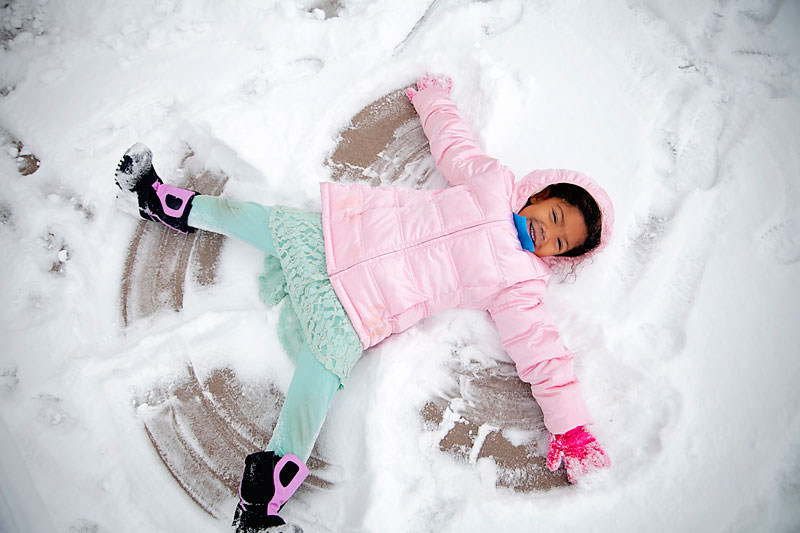
The biggest challenge when photographing snow lies in your camera’s metering system.
No matter how sophisticated the metering in an SLR camera is, it’s engineered to assume it’s reading “normal” subjects, of an “average” brightness. Photograph a landscape in summertime, with green grass, dark green trees, blue sky and white clouds, and the different brightness levels in the scene often average each other out. Much of the time, the meter will get these scenes absolutely correctly exposed. In simplified terms, it does this by averaging bright and dark parts of a scene, so the final exposure renders the overall brightness almost a middle shade of gray.
You may have heard the term “18% gray,” a middle shade of gray which, technically speaking, reflects 18% of the light striking it. This has been a universal reference point in photographic exposure meters for decades.
Just to clarify what that means: Middle gray is roughly the mid-tone on a gray scale — appearing to fall exactly between pure black and pure white. Subjects of this tone reflect about 18% of light (comparatively, white objects reflect nearly 100% and black objects reflect nearly 0%).
Simply put, most cameras assume that everything they photograph reflects 18% of the light, and expose accordingly. Put another way, your camera meters subjects assuming they should be photographically rendered as middle gray.
Freshly-fallen clean, white snow is obviously much lighter and more reflective than that, but the camera will automatically try to reproduce it as gray, by underexposing anywhere up to about two stops to correct for what it sees as a too-bright subject. This is exactly why many photographers will find their snow photos to be muddy and underexposed.
In-camera light metering works reasonably well with most subjects, in most lighting situations. However, there are tricky scenes that will baffle most meters — and snow is a classic example.
Most cameras have more than one metering mode (though they all use the basic reflective approach described above). These modes are not always found in every camera, but here are some of the common ones found in the Canon EOS and PowerShot systems:
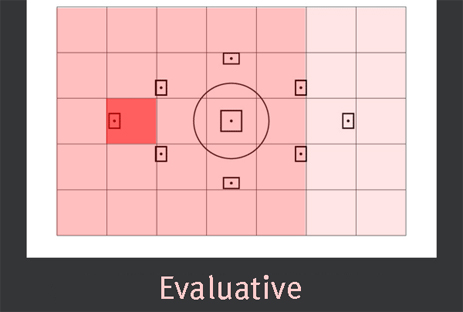
Evaluative: Metering is directly linked to, and concentrated on, the area around the active AF point, whether you’ve focused on something in the center or off-center. Light values measured at the active AF point are compared with light values measured from the metering segments across the remaining areas of the scene, and the camera's metering system attempts to provide an accurate exposure based on that comparison. This metering pattern is often effective when photographing people, but may not be quite as effective when photographing snowy landscapes depending on other elements in the scene. Note that because Evaluative Metering is linked to active AF points, focusing on a different subject may result in a very different exposure — even within the same scene. Note: In the simulated viewfinder, Evaluative mode is shown with the left-most AF point active.
Spot: The most selective metering option, it reads exposure information only from the single exposure zone in the center of the frame (approximately 3% of the total picture area).
Partial: Similar to Spot Metering, but covers a somewhat larger area, reading only the cross-shaped central five metering zones (approximately 10% of the total picture area) — some shooters think of it as a “fat spot.”
Center-weighted Average: This metering mode averages the exposure for the entire metering area, but with greater emphasis on the center metering zones. Unlike Evaluative metering, it does not compare brightness readings from different parts of the scene; it simply reads overall brightness.
Even though Evaluative metering is by far the most commonly-used system by EOS users, when using one of the EOS Creative Zone exposure modes (M, Tv, Av or P), you can select from any of the metering modes offered on your camera. If you prefer to shoot in the Basic Zone exposure modes (Full Auto, Portrait, Landscape, Close-up, Action, etc.), the default mode is usually Evaluative. This is also true in PowerShot cameras — although note that when Face Detection is turned on, any faces in the scene will have exposure priority.
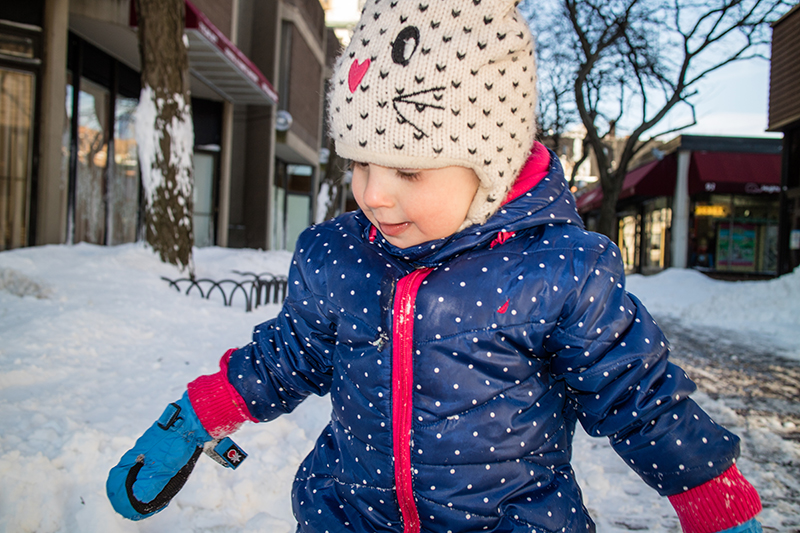
When photographing snow, any of these modes may be used effectively, depending on the overall scene. For example, if there is some contrast between the snow and the rest of the objects in the scene, then Evaluative metering may be ideal because it will emphasize the exposure for whatever you are focusing on — even if it’s off-center.
If the overall scene is evenly lit and of generally even brightness, then Center-weighted Average will work well to give a good overall exposure.
Spot and Partial metering will work well with subjects that have more extreme contrast, and/or when you want to carefully read one part of a subject or scene, and don’t want another part to ‘confuse’ the meter. Either way, they let you meter only a small part of the scene. These metering patterns are very useful when used in combination with the Auto Exposure (AE) Lock button found on most digital SLRs.
Unfortunately, even when the camera ‘accurately’ determines the correct exposure using the metering mode of your preference, with a subject like snow you will often see underexposed results. If and when this happens, however, you have a tool in your camera to deliberately lighten your pictures, and have the white snow properly rendered. That tool is Exposure Compensation.
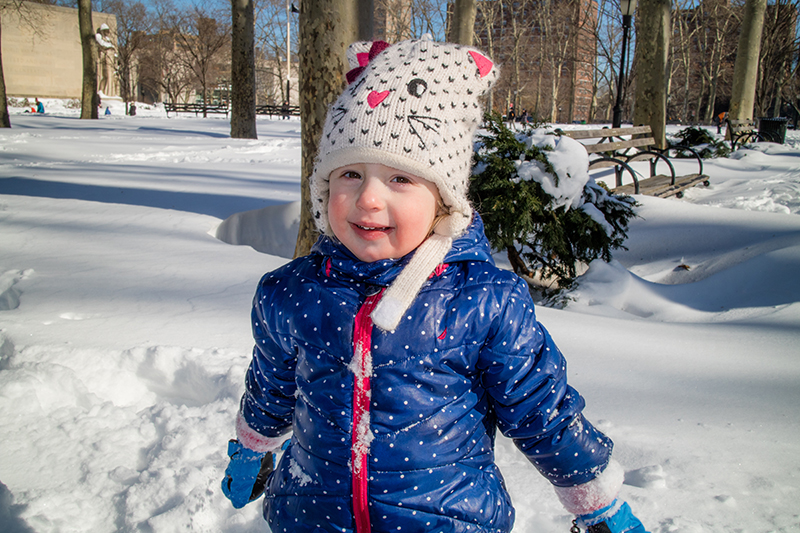
Exposure Compensation (EC) is the most important — and often, the easiest — way to get around your camera’s tendency to underexpose bright subjects, and overexpose dark ones. It’s also very useful for photographers who are new to Creative Zone shooting (again, the P, Tv, Av, and M settings on your Mode Dial) because it doesn’t require extensive knowledge of f-stops or shutter speeds.
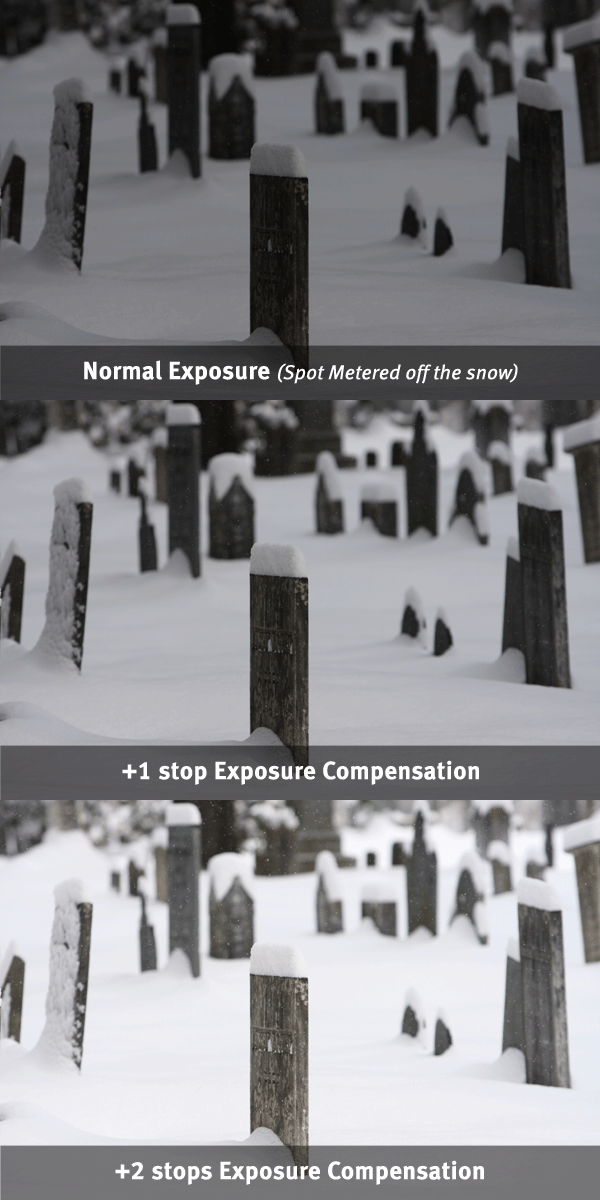
Exposure Compensation lets you deliberately lighten or darken your exposures. You can vary the amount of compensation, anywhere from plus or minus 1/3 of a stop (often, a barely noticeable difference) up to plus/minus three full stops, which will significantly change most images. Using “plus” compensation adds light, so it always deliberately lightens images you’re about to take.
Keep in mind that to use Exposure Compensation (and many other features), your camera has to be in a “Creative Zone” exposure mode… that is, the P, Av, Tv, or M settings on your camera’s Mode Dial. If your camera is set to one of the full-automatic settings, you can’t change exposure, and any Compensation you may have previously dialed-in while in a Creative Zone mode will be ignored.
You can also bracket several shots in a row, with each image of a slightly different exposure using the Auto Exposure Bracket (AEB) function.
When photographing snow, you’ll want to experiment with adding more exposure, anywhere from +1/3 to +2 stops EC may work, so play around until you find what you like or try using AEB to ensure variety in exposure levels.
Another approach is to shoot RAW images, which provide additional control over exposure compensation on a computer (bonus: you'll be in the warm comfort of your home instead of out in the cold!). However, understand that even when shooting RAW images, it's still necessary to start out with an exposure that's reasonably accurate out-of-camera — and we strongly recommend using Exposure Compensation to lighten snow images whenever it’s needed.
White Balance settings adjust the camera for the overall color character of the light source you are shooting in, so images can have a neutral rendition that properly renders colors in the scene. Many Canon EOS photographers let the camera read light and adjust this automatically, with Auto White Balance (AWB). There are also fixed, pre-set white balance settings, such as Daylight, Cloudy, Shade, and Tungsten.
Many cameras also allow shooters to take a custom White Balance, or even dial in a specific color temperature (measured in degrees Kelvin) to better match your scene, particularly for unusual or mixed-lighting scenes that are not covered by any of the preset options seen here.
Photographing snow implies you will be outside. However, differences in time of day, geographic region, and weather conditions can make a huge difference in the color temperature of your light source — even though the ‘light source’ in this case is always the sun, which means that your White Balance may need to be adjusted, and the preset for 'Daylight' may not always look the best.
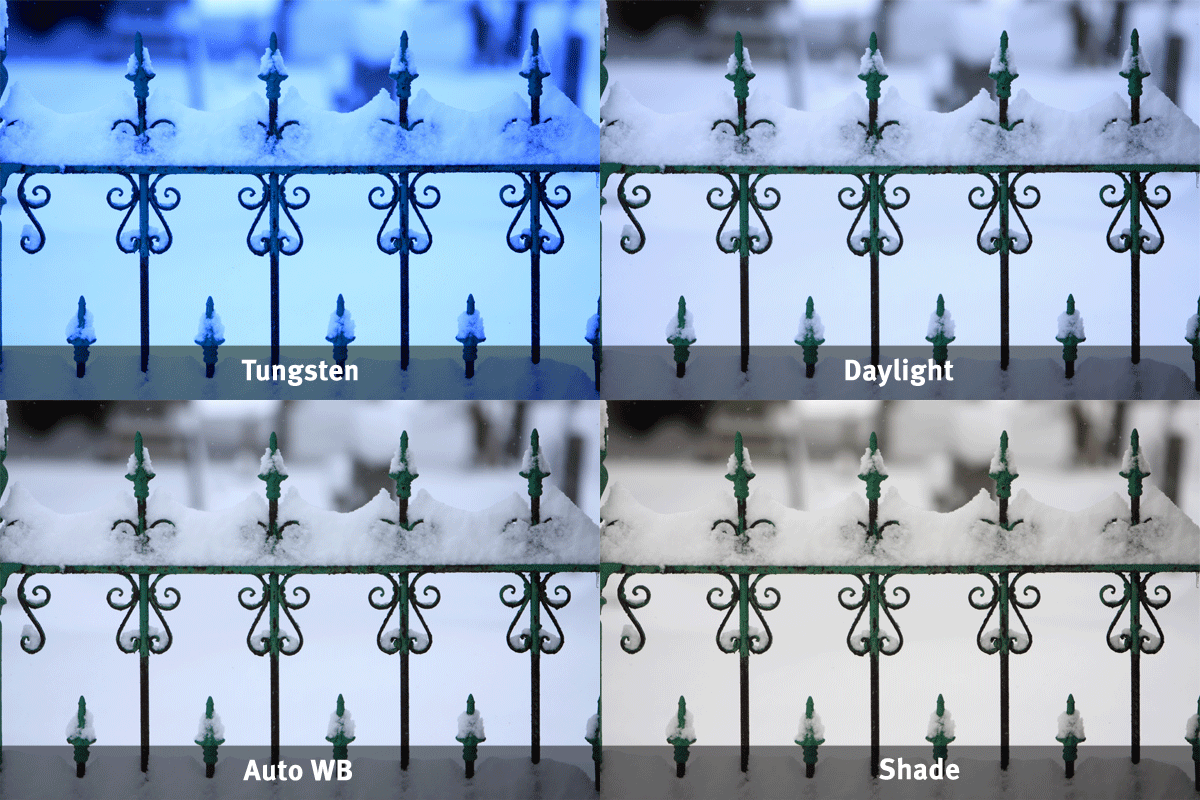
The preset White Balance options are pretty accurate, but you have to remember to use the one that most closely matches your light source, and weather conditions. On sunny days with clear blue skies, it’s common to have snow seem to pick up a slight blue tint; experiment with the Cloudy or Shade WB settings to warm-up the overall color and neutralize that blue color cast.
If you shoot RAW images, you can change your White Balance while editing, regardless of your camera settings at the time of shooting. But it still makes sense to deliberately set the proper white balance, or at least one that gets your color close, before you take the picture.
Another reason snow poses a challenge is because any white subject photographed in reasonably bright light is at risk of losing detail with even slight overexposure. Worse yet, once a scene has overexposed highlights, there is often little that can be done in photo editing to bring that detail back. Luckily, our current line of EOS digital SLRs offers a number of functions to help photographers avoid these unfortunate ‘blown out’ highlights.
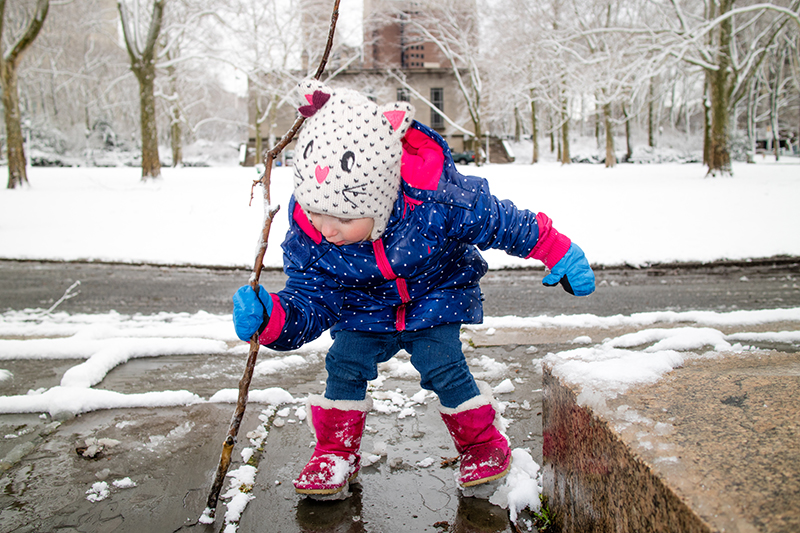
One easy-to-use, and very effective feature is Highlight Tone Priority (HTP). This innovative image-control feature takes advantage of the expanded tonal range found in newer EOS cameras to achieve up to one stop more detail in bright highlight areas — without effecting the overall exposure or underexposing the rest of the scene.
HTP can only be used in the Creative Zone exposure modes (again, P, Tv, Av, M, or A-DEP on your mode dial), and once it’s turned on, the effect will automatically be applied to JPEG images and even HD video files in-camera. Two notes for RAW image shooters:
- Highlight Tone Priority will be applied (if set in-camera) to RAW images if they are processed in Canon’s Digital Photo Professional software
- HTP is usually ignored if other third-party software is used to process EOS RAW image files, even if HTP was set in-camera
Please note that when HTP is active, the highest and lowest ISO settings of your camera may not be available. Some EOS models have Highlight Tone Priority control in the Shooting Menu; on other models, it’s within the Custom Functions menu.
In addition to Highlight Tone Priority, you can also manage your highlights during playback: by checking image histograms, and using the optional Highlight Alert function.
A histogram is a chart that represents the distribution of pixel brightness in each image. It is visible on the rear LCD screen during Live View shooting, or during playback, and is a very useful way to evaluate exposure. Histograms are sort of mountain-shaped; the height of each peak indicates how many pixels were recorded at particular brightness levels. The most important part, however, is how the display looks side-to-side. The left side of the chart represents shadow tones in the image; the right side represents bright highlight areas, and the center represents mid-tones.

Note that the pixels on the right side of the Histogram are cut off, which indicates overexposure.
Reading a histogram properly helps photographers determine the appropriate exposure for the scene, and whether they are at risk of severe under- or overexposure. When photographing snow, two things to keep in mind as you look at a histogram when playing-back an image:
- If the scene is mostly snow, but the histogram shows a big “mountain” in the middle area of the histogram, it usually means the camera has tried to make the snow middle-gray. This is your warning to set Exposure Compensation in the “plus” direction, and take another picture… your goal is snow that appears white, not gray!
- If snow has been properly-exposed and rendered a white tone in your image, you’ll probably see a lot of information to the far right side of the histogram. As long as it’s not being cut-off by the right side of the graph, this is a good sign… the histogram info is telling you your white subject is being reproduced as a white tone in your digital image.
But, if your histogram shows portions of the graph that appear to get cut off on the far right, that means portions of your scene are severely overexposing to the point that detail may be washed out. This is a warning that your exposure should be adjusted. If you see this, try applying minus Exposure Compensation, until you see that no part of your histogram is cut off at the right edge.
Another way to check for overexposure during LCD monitor playback is with a feature called Highlight Alert. When active, this alert causes all portions of the frame on the verge of overexposing to blink on and off. This is an optional feature that can be enabled or disabled on the Playback menu of most of our EOS digital models; with EOS Digital Rebel models, it’s displayed whenever the histogram is on-screen during Playback.
If you plan to shoot outdoors in the cold for an extended period of time, please consider the following precautions to ensure the safety and functionality of your camera equipment:
- Cold batteries die faster, especially in temperatures below the freezing point, so keep your batteries warm. Keep the camera relatively warm, and when possible, resist the temptation to leave it or your camera bag in cold places like the trunk of a car or unheated areas of a building for long periods of time. Also, bring spare batteries, fully-charged, and keep those warm in your pockets until ready for use
- Give your camera equipment time to acclimate when going from cold to warm temperatures. Otherwise, you risk condensation build-up, which can damage lenses as well as internal digital camera components. Gradually introduce it to warmer temperatures. One example would be to gently warm equipment using a car’s heater — not too much, however! — after cold-weather shooting, prior to bringing the gear into a heated building.
- Another trick to prevent condensation build-up when moving from cold to warm temperatures is to seal your camera in an airtight plastic bag (such as a Ziplock). Seal the camera completely inside of the bag BEFORE moving indoors, and condensation should form on the bag rather than the camera. Leave the camera inside the bag until it's had a chance to fully warm up to room temperature.
- If you anticipate mild snow or rain while shooting, waterproof your camera with plastic bags. Bring lens cloths or lint-free tissues to wipe off any moisture that might build up on the lens from melting snowflakes.
- Keep your hands warm. Invest in fingerless gloves with a fold-back mitten top, so you can access camera controls while keeping your hands as warm as possible in between shots.

This page exists within the Old ArtZone Wiki section of this site. Read the information presented on the linked page to better understand the significance of this fact.
- Ordered List Item
======Animating Falling Snow====== * Unordered List Item
Author: ctown4life
Tools Needed
- Any image editing program (such as Photoshop)
Support Files
Introduction
Animating Falling Snow in DAZ Studio
for Mr. Finnegan's Giving Chest
Illustration 3: Jake runs through the alley
Of course there were a variety of ways we could have created the falling snow for this scene. Not only did we want our falling snow to look convincing, with variation and depth, but we also wanted it to be versatile enough to be used in several different illustrations. We needed to be able to manipulate the snow easily and in real time, according to the art direction for any particular illustration. To accomplish this we choose to animate the snow. This allowed the Art Director to find a specific frame best suited for the final still image. Ultimately we achieved our goal using a few tricks and tools that are all available within DAZ Studio.
The following tutorial will show any DAZ Studio user how they can easily accomplish the same results.
An Adobe PDF version of this tutorial is available at www.givingchest.com - Behind the Scenes.

Step 1 - Create Planes

This is just a fun preview of the falling snow inside of DAZ Studio that we are going to create.
Explanation: To animate falling snow in DAZ Studio we will create several planes to which we will add opacity maps. We will use DAZ Studio's D-Form plug-in to manipulate the snow. And in the end we will animate several of these objects.
There are several plug-ins that you may have received when you initially downloaded DAZ Studio 1.0. We will use the D-Form plug-in and the Primitives plug-in.
If you don't have those plug-ins or DAZ Studio 1.0, you can download them from www.daz3D.com. You can still finish this tutorial without any of these plug-ins, but you will need to find workarounds.
ALSO, if you don't have the Primitives plug-in, or a 3D application for creating planes to import into DAZ Studio, I have attached a DAZ Studio scene file to this tutorial that already has 9 planes ready to use. Simply download the file and unzip it. (File found right above the beginning of Step 1, it's called “Planes.zip”)Let's get Started
1.Create a plane by choosing Create – New Primitive on the menu bar. Under Type, choose Plane and make sure Divisions is on at least 8. see image02
Tip: If you do not have the New Primitives plug-in, you can always import planes from another 3D application if you have one.
Scale and rotate the plane so you get about the same result as the plane shown in the image03 example .
Redo the process so that you have about 9 or 10 identical planes fairly evenly apart from each other as also shown in image03.
Step 2 - Parenting the Planes

2. Parent the planes together by selecting all of the planes but one (Plane 2 – Plane 9) and then drag and drop onto Plane, or the one that you didn't select. see image04
Rename Plane to Snow Planes, or something fun like that.
Tip: When you place objects under other objects as we did above it is called Parenting. Parenting is a good way to organize and work with content in your scene. The highest object in the group ('Snow Planes' in our example) is referred to as the parent. The objects under the parent are referred to as the children. The children will always follow the parent. Meaning if you translate or rotate or scale the parent, the children will do the same. see image04
Step 3 - Painting the Opacity Maps

3. In a painter program, like Photoshop, we will need to make an opacity map that will later be placed on the planes that we created earlier in DAZ Studio.
Tip: The opacity map will tell DAZ Studio which parts of the geometry to show and which parts to hide. When creating an opacity map, remember that anything black will not be seen (not renderable), and anything white will! Grays will result in a transparent object proportional to the value of grey.
4.To get the effect of snow we will need a map of mostly black, with a bunch of random white spots.
- see image 05
Save the file as a JPG and put it in a logical place on your hard drive.
Tip: When making maps, whether they be for texture or opacity or whatever, it is generally best to do them in increments of 64 X 64 pixels.(i.e. 128 X 128, 256 X 256, 512 X 512, 1024 X 1024, etc.)
The higher the resolution on the map the higher the resolution on the final render, but keep in mind higher resolution maps take up more resources and can potentially cause things to slow down.5. Back in DAZ Studio, open the surface editor, Windows – Surfaces. In the top right corner click on the right arrow and make sure the Show Surface List is checked on. - see image06
In the left column, select any one of the surfaces of the planes.
Now under the Advanced tab, scroll down to Opacity Strength and click on the down arrow next to the Opacity Strength Percentage Bar.
Select Browse for image and browse to the folder where you saved the opacity map you created earlier. Select the file, and press open.
- see image06
Tip: DAZ Studio allows you to set windows anywhere in the interface. Select the tab Surfaces and try dragging it around to different parts of the screen to see how it sets itself inside different windows. It can be placed in several different locations. Choose the place that works best for you and leave it there if you'd like.
Notice if you have placed it next to another tab, you will have to select the other tab to toggle back and forth between the two. This tip can increase your optimal workflow. Repeat the process so each plane has the opacity map as its source for opacity.
Tip: you can also use the copy/paste buttons found on the bottom of the Surfaces window. - see image07
Click in order: red, blue, purple, yellow.
Step 4 - OpenGL

6. In the top-left corner of your viewport next to the camera selection button, click on the right arrow and select Texture Shaded. - see image04
Tip: DAZ Studio is Open GL, which will allow us to see all of the texture and opacity maps in real time without rendering. This is a huge benefit and will also result in optimal workflow.
Tip: In the same drop down you can find the option to change your background color, I changed mine to black to be able to see the snow better.
You should now see something like image08.
Step 5 - Create snowCam

7. Now we want to parent the snow to a new camera for a convenience we will use later on.
Make a new camera by choosing Create – New Camera under the menu bar. Rename it to something logical, such as 'snowCam'.
Under the camera selection pull down, choose the camera you just made, you should now be looking through that camera.
- see image09In the viewport spin your camera until you are pretty much looking straight at the snow. Dolly in so you are close to the first plane.
- see image10We need to offset the planes so we don't get such a uniform look. Translate the planes so each is in a little different x, y, z location. Now is a good time to play around with the initial look of your snow, feel free to play around with the location of each plane, bring some closer to the camera, or farther, until you get the look you want.
Make sure the planes farthest away from the camera do not end inside of the renderable viewport, bring them closer to the camera if you need to. - see image10_b
Step 6 - Create D-Former

In your Scene window, parent SnowPlane to snowCam.
- see image11
Because we have parented, anytime we decide to change the position of the camera in our scene the snow will follow.8. Now we need to set up some deformers. (If you don't have the D-Formers plug-in, skip this chapter and go to number 9)
Start off by selecting ALL of the planes. (the children and the parent)
Goto Create – New D-Former on the menu bar. In the Scene window it should have created a D-Former_1_Base, a D-Former_1 and a D-Former_1_Field, unless you changed the name. We will use all of these.
- see image12
Tip: D-Formers are a powerful tool and can yield some great results. On the menu bar under Windows you can find a D-Form window. This window will give you more tools for D-Formers such as adding nodes, editing the splines, and even spawning morphs for you figure. We will not use those tools in this tutorial, but they are worth learning.
Step 7 - The Timeline

9. We will first animate the Snow falling. On the menu bar go to Windows – Timeline. Set the values as you see in image13 for: Total, Range, and FPS.
Make sure the playhead (large red triangle pointing down, see image13 red circle) is on frame 0, we are going to set a key on it. Let me explain a few tools found on the Timeline. See image14.
1. Loop – when you press play (7) it will loop the playback.
2. Add Key – will add a keyframe to the frame the playhead is on.
3. Delete Key – will delete the keyframe of the frame the playhead is on.
4. Playrange Start – will bring the playhead back to the first frame in your range.
5. Skip to Previous Keyframe – will go to the next keyframe to the left of where the playhead is.
6. Step to Previous Frame – will move the playhead back one frame.
7. Play – will play the animation in the range.
8. Step to Next Frame – will move the playhead forward one frame.
9. Skip to Next Keyframe – will go to the next keyframe to the right of where the playhead is.
10. Playrange End – will skip the playhead to the last frame in your range.
I will refer to several of these next
Step 8 - Animate the Snow Planes

We are now setup to animate the snow. Select Snow Planes, or the planes 'parent' in the Scene window. (at this point you should still be looking through snowCam)
Translate Snow Planes up so the edge of the snow is visible.
-see image15
Add a keyframe at frame 0 on your timeline. (button number 2 [add key] from image14)Move the playhead to frame 600, the last frame in your timeline. Now translate Snow Planes down so the edge of the snow is visible.
Notice: Here we won't have to add a keyframe since we created one on the first frame. Because we have translated our object Snow Planes, the last frame holds a different value for the translation. So DAZ Studio will create a keyframe for us. Keep this rule in mind, if you already have a keyframe and you translate, rotate, or scale your object, it will set a keyframe where ever your playhead is. If you're not paying attention this could add more animation then you may want.
- see image16
Scrub (move) your playhead across the timeline to see if the snow moves. If it does you're on track, if not, go back and figure out what you missed.
Step 9 - Animate D-Former part1

Now we are going to animate the D-Former Field, so select it in the Scene window. Under the Parameters window set the Opacity, found at the bottom, to 100%. This will allow us to see what we are doing.
Let's get into a different camera view. Under the select camera pull down choose your perspective camera.
Scale the Field so it is about 2 or 3 times larger than all of the planes. It should look something like image17.
FYI: All of the dots represent the vertices of the geometry. The more red a vertex is, the more the field will influence it. The more yellow, the less the field will influence it.

Make sure the playhead is at the beginning of the timeline. (button number 4, [Playrange Start] from image14). Translate the D-Former Field so that its origin is behind the camera.
- see image18
Also, make sure you don't go too far, you still want the last plane to be inside of the field. The vertices farthest from the camera should be yellowish.
Step 10 - Animate D-Former part2

Move the playhead to the last frame on the timeline (button number 10, [Playrange End] from image14) and translate the D-Former Field so that its origin is on the far side of the planes.
- see image19
Notice how everything has also translated down, this is correct and good. We will now animate D-Former_1. Select it in the Scene window.
Also, let's go back and look through the camera we created, snowCam.
Make sure the playhead is at the beginning of the timeline. (button number 4, [Playrange Start] from image14).
Translate D-Former_1 to 100 on the Z-axis. Look in the Parameters window under the Z Translate dial to get it accurate. (or you can right click and type in the value 100)
- see image20
Add a keyframe at frame 0 on your timeline. (button number 2 [add key] from image14)
Move the playhead forward so you are on frame 200. And translate D-Former_1 back to 0. (or type the value in the Z Translate dial) A keyframe will be made automatically by DAZ Studio.
- see image20
Move the playhead forward so you are on frame 400. And translate D-Former_1 back to 100.
Move the playhead forward so you are on the last frame (button number 10, [Playrange End] from image14) and translate D-Former_1 back to 0.
Step 11 - Customizing and Final Notes
TA DAH!!! We're Done, scrub the playhead across the timeline or press the Play button and watch your beautiful snow blow in the wind.
Feel free to play with the values of the keyframes we made. For example, if you want it to feel windier simply change keyframes 0 and 400 from 100 on the Z Translate to a much higher number, like 200. Also, to get a less uniform look, change the location of your keyframes (by deleting and re-adding on a different frame). You could also add new keyframes on different frames.
Save the file as 'Falling Snow' or something like that, and in the future when you have a scene you want to add snow to, simply open this file and there ya go. Scrub the timeline until you find the perfect frame for your scene and your set.
The falling snow that you learned in this tutorial was made to meet the needs of a specific still image. Although it has proven to be versatile, the animation is still rough. If your final product was an animation rather than a still image, you would want to spend more time refining it.
We hope you enjoyed this tutorial and behind the scenes look at
the making of Illustration 3 in
Mr. Finnegan's Giving Chest
Please visit www.givingchest.com for more on Mr. Finnegan's Giving Chest.
What’s New in the Snow Fall Scenes Saver serial key or number?
Screen Shot

System Requirements for Snow Fall Scenes Saver serial key or number
- First, download the Snow Fall Scenes Saver serial key or number
-
You can download its setup from given links:

Snow Fall Scenes Saver serial key or number & Kali Software Crack

Snow Fall Scenes Saver serial key or number& Key Download

Snow Fall Scenes Saver serial key or number
About Author
