
Love chess 2 serial key or number
Love chess 2 serial key or number
Bobby Fischer
Robert James Fischer (March 9, 1943 – January 17, 2008) was an American chess grandmaster and the eleventh World Chess Champion.
A chess prodigy, at age 13 he won a game which was dubbed "The Game of the Century". At age 14, he became the youngest ever U.S. Chess Champion, and at 15, he became both the youngest grandmaster (GM) up to that time and the youngest candidate for the World Championship. At age 20, Fischer won the 1963/64 US Championship with 11 wins in 11 games, the only perfect score in the history of the tournament. His book My 60 Memorable Games, published in 1969, is regarded as essential reading in chess literature. He won the 1970 Interzonal Tournament by a record 3½-point margin, and won 20 consecutive games, including two unprecedented 6–0 sweeps, in the Candidates Matches. In July 1971, he became the first official FIDE number-one-rated player. His Elo rating of 2785 the following year was 125 points ahead of World Champion Boris Spassky,[2] and is the largest rating gap ever recorded between the first and second rated players.[3] This rating stood as a record until 1990.
Fischer won the World Chess Championship in 1972, defeating Boris Spassky of the USSR, in a match held in Reykjavík, Iceland. Publicized as a Cold War confrontation between the US and USSR, it attracted more worldwide interest than any chess championship before or since. In 1975, Fischer refused to defend his title when an agreement could not be reached with FIDE, chess's international governing body, over one of the conditions for the match. Under FIDE rules, this resulted in Soviet GM Anatoly Karpov, who had won the qualifying Candidates' cycle, being named the new world champion by default.
After forfeiting his title as World Champion, Fischer became reclusive and sometimes erratic, disappearing from both competitive chess and the public eye. In 1992, he reemerged to win an unofficial rematch against Spassky. It was held in Yugoslavia, which was under a United Nationsembargo at the time. His participation led to a conflict with the US government, which warned Fischer that his participation in the match would violate an executive order imposing US sanctions on Yugoslavia. The US government ultimately issued a warrant for his arrest. After that, Fischer lived as an émigré. In 2004, he was arrested in Japan and held for several months for using a passport that had been revoked by the US government. Eventually, he was granted an Icelandic passport and citizenship by a special act of the Icelandic Althing, allowing him to live in Iceland until his death in 2008.
Fischer made numerous lasting contributions to chess. In the 1990s, he patented a modified chess timing system that added a time increment after each move, now a standard practice in top tournament and match play. He also invented Fischer random chess, also known as Chess960, a chess variant in which the initial position of the pieces is randomized to one of 960 possible positions.
Early years
Bobby Fischer was born at Michael Reese Hospital in Chicago, Illinois, on March 9, 1943.[4] His mother, Regina Wender Fischer, was a US citizen,[5][6] born in Switzerland; her parents were Polish Jews.[7][8] Raised in St. Louis, Missouri,[4] Regina became a teacher, registered nurse, and later a physician.[9]
After graduating from college in her teens, Regina traveled to Germany to visit her brother. It was there she met geneticist and future Nobel Prize winner Hermann Joseph Muller, who persuaded her to move to Moscow to study medicine. She enrolled at I.M. Sechenov First Moscow State Medical University, where she met Hans-Gerhardt Fischer, also known as Gerardo Liebscher,[10] a German biophysicist, whom she married in November 1933.[11] In 1938, Hans-Gerhardt and Regina had a daughter, Joan Fischer. The reemergence of anti-Semitism under Stalin prompted Regina to go with Joan to Paris, where Regina became an English teacher. The threat of a German invasion led her and Joan to go to the United States in 1939. Regina and Hans-Gerhardt had already separated in Moscow, although they did not officially divorce until 1945.[11]
At the time of her son's birth, Regina was homeless[12] and shuttled to different jobs and schools around the country to support her family. She engaged in political activism, and raised both Bobby and Joan as a single parent.[13][14][15]
In 1949, the family moved to Manhattan[16] and the following year to Brooklyn, New York City, where she studied for her master's degree in nursing and subsequently began working in that field.[14]
Paul Nemenyi as Fischer's father
In 2002, Peter Nicholas and Clea Benson of The Philadelphia Inquirer published an investigative report backed by detailed and compelling evidence that indicated that Bobby Fischer's biological father was actually Paul Nemenyi.[15][17][18] Nemenyi, a Hungarian mathematician and physicist of Jewish heritage, was considered an expert in fluid and applied mechanics. Benson and Nicholas continued their work and gathered additional evidence in court records, personal interviews, and even a summary of the FBI investigation written by J. Edgar Hoover, which confirmed their earlier conclusions.[19]
Throughout the 1950s, the FBI investigated Regina and her circle for her alleged communist sympathies, as well as her time living in Moscow.[20] FBI files note that Hans-Gerhardt Fischer never entered the United States, while recording that Nemenyi took a keen interest in Fischer's upbringing.[17][21][22] Not only were Regina and Nemenyi reported to have had an affair in 1942, but Nemenyi made monthly child support payments to Regina and paid for Bobby's schooling until his own death in 1952.[23] In addition, Nicholas and Benson found letters by Nemenyi's first son, Peter, identifying Bobby Fischer as his brother.[citation needed]
Chess beginnings
In March 1949, 6-year-old Bobby and his sister Joan learned how to play chess using the instructions from a set bought at a candy store.[24] When Joan lost interest in chess and Regina did not have time to play, Fischer was left to play many of his first games against himself.[25] When the family vacationed at Patchogue, Long Island, New York, that summer, Bobby found a book of old chess games and studied it intensely.[26]
In 1950, the family moved to Brooklyn, first to an apartment at the corner of Union Street and Franklin Avenue, and later to a two-bedroom apartment at 560 Lincoln Place.[27] It was there that "Fischer soon became so engrossed in the game that Regina feared he was spending too much time alone".[14] As a result, on November 14, 1950, Regina sent a postcard to the Brooklyn Eagle newspaper, seeking to place an ad inquiring whether other children of Bobby's age might be interested in playing chess with him. The paper rejected her ad, because no one could figure out how to classify it, but forwarded her inquiry to Hermann Helms, the "Dean of American Chess", who told her that MasterMax Pavey, former Scottish champion, would be giving a simultaneous exhibition on January 17, 1951.[28][29] Fischer played in the exhibition. Although he held on for 15 minutes, drawing a crowd of onlookers, he eventually lost to the chess master.[30]
One of the spectators was Brooklyn Chess Club President,[31]Carmine Nigro, an American chess expert of near master strength and an instructor.[32] Nigro was so impressed with Fischer's play[31] that he introduced him to the club and began teaching him.[33][34][35] Fischer noted of his time with Nigro:[36] "Mr. Nigro was possibly not the best player in the world, but he was a very good teacher. Meeting him was probably a decisive factor in my going ahead with chess."
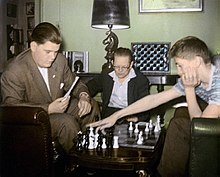
Nigro hosted Fischer's first chess tournament at his home in 1952.[37] In the summer of 1955, Fischer, then 12 years old, joined the Manhattan Chess Club.[38][39] Fischer's relationship with Nigro lasted until 1956, when Nigro moved away.[40][41]
The Hawthorne Chess Club
In June 1956, Fischer began attending the Hawthorne Chess Club, based in master John "Jack" W. Collins' home.[42] Collins taught chess to children, and has been described as Fischer's teacher,[43][44] but Collins himself suggested that he did not actually teach Fischer,[45] and the relationship might be more accurately described as one of mentorship.[46]
Fischer played thousands of blitz and offhand games with Collins and other strong players, studied the books in Collins' large chess library, and ate almost as many dinners at Collins' home as his own.[47][48][49]
Young champion
On the tenth national rating list of the United States Chess Federation (USCF), published on May 20, 1956, Fischer's rating was 1726,[50] more than 900 points below top-rated Samuel Reshevsky (2663).[51] His playing strength increased rapidly that year.[52]

In March 1956, the Log Cabin Chess Club of West Orange, New Jersey (based in the home of the club's eccentric multi-millionaire founder and patron Elliot Forry Laucks) took Fischer on a tour to Cuba, where he gave a 12-board simultaneous exhibition at Havana's Capablanca Chess Club, winning ten games and drawing two.[53][54] On this tour the club played a series of matches against other clubs. Fischer played , behind International Master Norman Whitaker. Whitaker and Fischer were the leading scorers for the club, each scoring 5½ points out of 7 games.[55]
In July 1956, Fischer won the US Junior Chess Championship, scoring 8½/10 at Philadelphia to become the youngest-ever Junior Champion at age 13.[56][57] At the 1956 US Open Chess Championship in Oklahoma City, he scored 8½/12 to tie for 4th–8th places, with Arthur Bisguier winning.[58] In the first Canadian Open Chess Championship at Montreal 1956, he scored 7/10 to tie for 8th–12th places, with Larry Evans winning.[59] In November, Fischer played in the 1956 Eastern States Open Championship in Washington, D.C., tying for second with William Lombardy, Nicholas Rossolimo, and Arthur Feuerstein, with Hans Berliner taking first by a half-point.[60]
Fischer accepted an invitation to play in the Third Lessing J. Rosenwald Trophy Tournament in New York City (1956), a premier tournament limited to the 12 players considered the best in the US.[61] Although Fischer's rating was not among the top 12 in the country, he received entry by special consideration. Playing against top opposition, the 13-year-old Fischer could only score 4½/11, tying for 8th–9th place.[62] Yet he won the [63] for his game against International Master Donald Byrne,[61] in which Fischer sacrificed his queen to unleash an unstoppable attack. Hans Kmoch called it "The Game of the Century",[64] writing: "The following game, a stunning masterpiece of play performed by a boy of 13 against a formidable opponent, matches the finest on record in the history of chess prodigies".[65][66] According to Frank Brady, "'The Game of the Century' has been talked about, analyzed, and admired for more than fifty years, and it will probably be a part of the canon of chess for many years to come."[67] "In reflecting on his game a while after it occurred, Bobby was refreshingly modest: 'I just made the moves I thought were best. I was just lucky.'"[68]
In 1957, Fischer played a two-game match against former World Champion Max Euwe at New York, losing ½–1½.[69][70][71] On the USCF's eleventh national rating list, published on May 5, 1957, Fischer was rated 2231—over 500 points higher than his rating a year before.[72] This made him the country's youngest ever chess master up to that point.[73] In July, he successfully defended his US Junior title, scoring 8½/9 at San Francisco.[74] As a result of his strong tournament results, Fischer's rating went up to 2298, "making him among the top ten active players in the country".[75] In August, he scored 10/12 at the US Open Chess Championship in Cleveland, winning on tie-breaking points over Arthur Bisguier.[76][77] This made Fischer the youngest ever US Open Champion.[78][79] He won the New Jersey Open Championship, scoring 6½/7.[80] He then defeated the young Filipino master Rodolfo Tan Cardoso 6–2 in a New York match sponsored by Pepsi-Cola.[81][82]
Wins first US title
Based on Fischer's rating and strong results, the USCF invited him to play in the 1957/58 US Championship.[83] The tournament included such luminaries as six-time US champion Samuel Reshevsky, defending US champion Arthur Bisguier, and William Lombardy, who in August had won the World Junior Championship.[84] Bisguier predicted that Fischer would "finish slightly over the center mark".[84][85] Despite all the predictions to the contrary, Fischer scored eight wins and five draws to win the tournament by a one-point margin, with 10½/13.[86][87] Still two months shy of his 15th birthday, Fischer became the youngest ever US champion.[88] Since the championship that year was also the US Zonal Championship, Fischer's victory earned him the title of International Master.[89][90] Fischer's victory in the US Championship sent his rating up to 2626, making him the second highest rated player in the United States, behind only Reshevsky (2713),[91] and qualified him to participate in the 1958 Portorož Interzonal, the next step toward challenging the World Champion.[81]
Grandmaster, candidate, author
Bobby wanted to go to Moscow. At his pleading, "Regina wrote directly to the Soviet leader, Nikita Khrushchev, requesting an invitation for Bobby to participate in the World Youth and Student Festival. The reply—affirmative—came too late for him to go."[92] Regina did not have the money to pay the airfare, but in the following year Fischer was invited onto the game show I've Got a Secret, where, thanks to Regina's efforts, the producers of the show arranged two round-trip tickets to the Soviet Union.[93][94]
Once in Russia, Fischer was invited by the Soviet Union to Moscow,[95] where International Master Lev Abramov would serve as a guide to Bobby and his sister, Joan.[96] Upon arrival, Fischer immediately demanded that he be taken to the Moscow Central Chess Club,[97] where he played speed chess with "two young Soviet masters", Evgeni Vasiukov and Alexander Nikitin,[98] winning every game.[97] Chess author V. I. Linder writes about the impression Fischer gave grandmaster Vladimir Alatortsev when he played blitz against the Soviet masters: "Back in 1958, in the Central Chess Club, Vladimir Alatortsev saw a tall, angular 15-year-old youth, who in blitz games, crushed almost everyone who crossed his path… Alatortsev was no exception, losing all three games. He was astonished by the play of the young American Robert Fischer, his fantastic self-confidence, amazing chess erudition and simply brilliant play! On arriving home, Vladimir said in admiration to his wife: 'This is the future world champion!'"[99]
Fischer demanded to play against Mikhail Botvinnik, the reigning World Champion. When told that this was impossible, Fischer asked to play Paul Keres. "Finally, Tigran Petrosian was, on a semi-official basis, summoned to the club …" where he played speed games with Fischer, winning the majority.[100] "When Bobby discovered that he wasn't going to play any formal games … he went into a not-so-silent rage",[101] saying he was fed up "with these Russian pigs",[102] which angered the Soviets who saw Fischer as their honored guest. It was then that the Yugoslavian chess officials offered to take in Fischer and Joan as early guests to the Interzonal. Fischer took them up on the offer, arriving in Yugoslavia to play two short training matches against masters Dragoljub Janošević and Milan Matulović.[103] Fischer drew both games against Janošević and then defeated Matulović in Belgrade by 2½–1½.[104]
At Portorož, Fischer was accompanied by Lombardy.[105][106] The top six finishers in the Interzonal would qualify for the Candidates Tournament.[107] Most observers doubted that a 15-year-old with no international experience could finish among the six qualifiers at the Interzonal, but Fischer told journalist Miro Radoicic, "I can draw with the grandmasters, and there are half-a-dozen in the tournament I reckon to beat."[108][a] Despite some bumps in the road and a problematic start, Fischer succeeded in his plan: after a strong finish, he ended up with 12/20 (+6−2=12) to tie for 5th–6th.[110] The Soviet grandmaster Yuri Averbakh observed,
In the struggle at the board this youth, almost still a child, showed himself to be a full-fledged fighter, demonstrating amazing composure, precise calculation and devilish resourcefulness. I was especially struck not even by his extensive opening knowledge, but his striving everywhere to seek new paths. In Fischer's play an enormous talent was noticeable, and in addition one sensed an enormous amount of work on the study of chess.[111]
Soviet grandmaster David Bronstein said of Fischer's time in Portorož: "It was interesting for me to observe Fischer, but for a long time I couldn't understand why this 15-year-old boy played chess so well".[112] Fischer became the youngest person ever to qualify for the Candidates and the youngest ever grandmaster at 15 years, 6 months, 1 day.[b] "By then everyone knew we had a genius on our hands."[114]
Before the Candidates' Tournament, Fischer won the 1958/59 US Championship (scoring 8½/11).[115] He tied for third (with Borislav Ivkov) in Mar del Plata (scoring 10/14), a half-point behind Luděk Pachman and Miguel Najdorf.[116] He tied for 4th–6th in Santiago (scoring 7½/12) behind Ivkov, Pachman, and Herman Pilnik.[117]
At the Zürich International Tournament, spring 1959, Fischer finished a point behind future World Champion Mikhail Tal and a half-point behind Yugoslavian grandmaster Svetozar Gligorić.[118][119][120]
Although Fischer had ended his formal education at age 16, dropping out of Erasmus Hall High School in Brooklyn, he subsequently taught himself several foreign languages so he could read foreign chess periodicals.[121] According to Latvian chess master Alexander Koblencs, even he and Tal could not match the commitment that Fischer had made to chess. Recalling a conversation from the tournament: "'Tell me, Bobby,' Tal continued, 'what do you think of the playing style of Larissa Volpert?' 'She's too cautious. But you have another girl, Dmitrieva. Her games do appeal to me!' Here we were left literally open-mouthed in astonishment. Misha and I have looked at thousands of games, but it never even occurred to us to study the games of our women players. How could we find the time for this?! Yet Bobby, it turns out, had found the time!'"[122]
Until late 1959, Fischer "had dressed atrociously for a champion, appearing at the most august and distinguished national and international events in sweaters and corduroys."[123] Now, encouraged by Pal Benko to dress more smartly, Fischer "began buying suits from all over the world, hand-tailored and made to order."[124][125] He told journalist Ralph Ginzburg that he had 17 hand-tailored suits and that all of his shirts and shoes were handmade.[126]
At the age of 16, Fischer finished equal fifth out of eight at the 1959 Candidates Tournament in Bled/Zagreb/Belgrade, Yugoslavia,[127] scoring 12½/28. He was outclassed by tournament winner Tal, who won all four of their individual games.[128] That year, Fischer released his first book of collected games: Bobby Fischer's Games of Chess, published by Simon & Schuster.[129]
Drops out of school
Fischer's interest in chess became more important than schoolwork, to the point that "by the time he reached the fourth grade, he'd been in and out of six schools."[130] In 1952, Regina got Bobby a scholarship (based on his chess talent and "astronomically high IQ") to Brooklyn Community Woodward.[131][c] Fischer later attended Erasmus Hall High School at the same time as Barbra Streisand and Neil Diamond.[133][134] In 1959, its student council awarded him a gold medal for his chess achievements.[135][136] The same year, Fischer dropped out of high school when he turned 16, the earliest he could legally do so.[137][138] He later explained to Ralph Ginzburg, "You don't learn anything in school."[139][140]
When Fischer was 16, his mother moved out of their apartment to pursue medical training. Her friend Joan Rodker, who had met Regina when the two were "idealistic communists" living in Moscow in the 1930s, believes that Fischer resented his mother for being mostly absent as a mother, a communist activist and an admirer of the Soviet Union and that this led to his hatred for the Soviet Union. In letters to Rodker, Fischer's mother states her desire to pursue her own "obsession" of training in medicine and writes that her son would have to live in their Brooklyn apartment without her: "It sounds terrible to leave a 16-year-old to his own devices, but he is probably happier that way".[6] The apartment was on the edge of Bedford-Stuyvesant, a neighborhood that had one of the highest homicide and general crime rates in New York City.[141] Despite the alienation from her son, Regina, in 1960, protested the practices of the American Chess Foundation[142] and staged a five-hour protest in front of the White House, urging President Dwight D. Eisenhower to send an American team to that year's chess Olympiad (set for Leipzig, East Germany, behind the Iron Curtain) and to help support the team financially.[18]
US Championships
Fischer played in eight US Championships, winning all of them,[143][144] by at least a one-point margin.[145] His results were:[143][146][147]
Fischer missed the 1961/62 Championship (he was preparing for the 1962 Interzonal), and there was no 1964/65 event.[157] In his eight US Chess Championships, Fischer lost only three games; to Edmar Mednis in the 1962/63 event, and in consecutive rounds to Samuel Reshevsky, and Robert Byrne in the 1965 championship, culminating in a total score of 74/90 (61 wins, 26 draws, 3 losses).[158]
Olympiads
Fischer refused to play in the 1958 Munich Olympiad when his demand to play ahead of Samuel Reshevsky was rejected.[159] Some sources claim that 15-year-old Fischer was unable to arrange leave from attending high school.[160] Fischer later represented the United States on first board at four Men's Chess Olympiads, winning two individual Silver and one individual Bronze medals:[161]
Out of four Men's Chess Olympiads, Fischer scored +40−7=18, for 49/65: 75.4%.[167][168] In 1966, Fischer narrowly missed the individual gold medal, scoring 88.23% to World Champion Tigran Petrosian's 88.46%. He played four games more than Petrosian, faced stiffer opposition,[169] and would have won the gold if he had accepted Florin Gheorghiu's draw offer, rather than declining it and suffering his only loss.[170]
At the 1962 Varna Olympiad, Fischer predicted that he would defeat Argentinian GM Miguel Najdorf in 25 moves. Fischer actually did it in 24, becoming the only player to beat Najdorf in the tournament.[171] Ironically, Najdorf lost the game while employing the very opening variation named after him: the Sicilian Najdorf.[172]
Fischer had planned to play for the US at the 1968 Lugano Olympiad, but backed out when he saw the poor playing conditions.[173] Both former World Champion Tigran Petrosian and Belgian-American International Master George Koltanowski, the leader of the American team that year, felt that Fischer was justified in not participating in the Olympiad.[174] According to Lombardy, Fischer's non-participation was due to Reshevsky's refusal to yield first board.[175]
1960–61
In 1960, Fischer tied for first place with Soviet star Boris Spassky at the strong Mar del Plata Tournament in Argentina, winning by a two-point margin, scoring 13½/15 (+13−1=1),[176][177] ahead of David Bronstein.[178] Fischer lost only to Spassky; this was the start of their lifelong friendship.[179]
Fischer experienced the only failure in his competitive career[180] at the Buenos Aires Tournament (1960), finishing with 8½/19 (+3−5=11), far behind winners Viktor Korchnoi and Samuel Reshevsky with 13/19.[181] According to Larry Evans, Fischer's first sexual experience was with a girl to whom Evans introduced him during the tournament.[182][183] Pal Benko said that Fischer did horribly in the tournament "because he got caught up in women and sex. Afterwards, Fischer said he'd never mix women and chess together, and kept the promise."[184] Fischer concluded 1960 by winning a small tournament in Reykjavík with 4½/5,[185] and defeating Klaus Darga in an exhibition game in West Berlin.[186]
In 1961, Fischer started a 16-game match with Reshevsky, split between New York and Los Angeles.[187] Reshevsky, 32 years Fischer's senior, was considered the favorite, since he had far more match experience and had never lost a set match. After 11 games and a tie score (two wins apiece with seven draws), the match ended prematurely due to a scheduling dispute between Fischer and match organizer and sponsor Jacqueline Piatigorsky. Reshevsky was declared the winner, by default, and received the winner's share of the prize fund.[188]
Fischer was second in a super-class field, behind only former World Champion Tal, at Bled, 1961.[189] Yet, Fischer defeated Tal head-to-head for the first time in their individual game, scored 3½/4 against the Soviet contingent, and finished as the only unbeaten player, with 13½/19 (+8−0=11).[190][191]
1962: success, setback, accusations of collusion
Fischer won the 1962 Stockholm Interzonal by a 2½-point margin,[192] going undefeated, with 17½/22 (+13−0=9).[193][194] He was the first non-Soviet player to win an Interzonal since FIDE instituted the tournament in 1948.[195] Russian grandmaster Alexander Kotov said of Fischer:[196]
I have discussed Fischer's play with Max Euwe and Gideon Stahlberg. All of us, experienced 'tournament old-timers', were surprised by Fischer's endgame expertise. When a young player is good at attacking or at combinations, this is understandable, but a faultless endgame technique at the age of 19 is something rare. I can recall only one other player who at that age was equally skillful at endgames – Vasily Smyslov.
Fischer's victory made him a favorite for the Candidates Tournament in Curaçao.[197][198] Yet, despite his result in the Interzonal, Fischer only finished fourth out of eight with 14/27 (+8−7=12),[199] far behind Tigran Petrosian (17½/27), Efim Geller, and Paul Keres (both 17/27).[200] Tal fell very ill during the tournament, and had to withdraw before completion. Fischer, a friend of Tal, was the only contestant who visited him in the hospital.[201]
Accuses Soviets of collusion
Following his failure in the 1962 Candidates,[d] Fischer asserted in a Sports Illustrated article,[203] that three of the five Soviet players (Tigran Petrosian, Paul Keres, and Efim Geller) had a prearranged agreement to quickly draw their games against each other in order to conserve their energy for playing against Fischer. It is generally thought that this accusation is correct.[204][205] Fischer stated that he would never again participate in a Candidates' tournament, since the format, combined with the alleged collusion, made it impossible for a non-Soviet player to win. Following Fischer's article, FIDE, in late 1962, voted to implement a radical reform of the playoff system, replacing the Candidates' tournament with a format of one-on-one knockout matches; the format that Fischer would dominate in 1971.[205][206]
Fischer defeated Bent Larsen in a summer 1962 exhibition game in Copenhagen for Danish TV. Later that year, Fischer beat Bogdan Śliwa in a team match against Poland in Warsaw.[207]
In the 1962/63 US Championship, Fischer lost to Edmar Mednis in round one. It was his first loss ever in a US Championship. Bisguier was in excellent form, and Fischer caught up to him only at the end. Tied at 7–3, the two met in the final round. Bisguier stood well in the middlegame, but blundered, handing Fischer his fifth consecutive US championship.[208]
Semi-retirement in the mid-1960s
Influenced by ill will over the aborted 1961 match against Reshevsky, Fischer declined an invitation to play in the 1963 Piatigorsky Cup tournament in Los Angeles, which had a world-class field.[208] He instead played in the Western Open in Bay City, Michigan, which he won with 7½/8.[209][210] In August–September 1963, Fischer won the New York State Championship at Poughkeepsie, with 7/7, his first perfect score,[211] ahead of Arthur Bisguier and James Sherwin.[212]
In the 1963/64 US Championship, Fischer achieved his second perfect score, this time against the top-ranked chess players in the country.[153][208] This result brought Fischer heightened fame, including a profile in Life magazine.[213]Sports Illustrated diagrammed each of the 11 games in its article, "The Amazing Victory Streak of Bobby Fischer".[214] Such extensive chess coverage was groundbreaking for the top American sports magazine. His 11–0 win in the 1963/64 Championship is the only perfect score in the history of the tournament,[215] and one of about ten perfect scores in high-level chess tournaments ever.[216][217][218]David Hooper and Kenneth Whyld called it "the most remarkable achievement of this kind".[216] Fischer recalls:[219] "Motivated by my lopsided result (11–0!), Dr. [Hans] Kmoch congratulated [Larry] Evans (the runner up) on 'winning' the tournament… and then he congratulated me on 'winning the exhibition'."
Fischer's 21-move victory against Robert Byrne won the brilliancy prize for the tournament. Byrne wrote:
The culminating combination is of such depth that, even at the very moment at which I resigned, both grandmasters who were commenting on the play for the spectators in a separate room believed I had a won game![220]
International Master Anthony Saidy recalled his last round encounter with the undefeated Fischer:[221]
Going into the final game I certainly did not expect to upset Fischer. I hardly knew the opening but played simply, and he went along with the scenario, opting for a N-v-B [i.e., Knight vs. Bishop] endgame with a minimal edge. In the corridor, Evans said to me, "Good. Show him we're not all children."
At adjournment, Saidy saw a way to force a draw, yet "sealed a different, wrong move", and lost.[221] "Chess publications around the world wrote of the unparalleled achievement. Only Bent Larsen, always a Fischer detractor, was unimpressed: 'Fischer was playing against children'".[222]
Fischer, eligible as US Champion, decided against his participation in the 1964 Amsterdam Interzonal, taking himself out of the 1966 World Championship cycle,[223] even after FIDE changed the format of the eight-player Candidates Tournament from a round-robin to a series of knockout matches, which eliminated the possibility of collusion.[213] Instead, Fischer embarked on a tour of the United States and Canada from February through May, playing a simultaneous exhibition, and giving a lecture in each of more than 40 cities.[224] He had a 94% winning percentage over more than 2,000 games.[224] Fischer declined an invitation to play for the US in the 1964 Olympiad in Tel Aviv.[225]
Successful return

Fischer wanted to play in the Capablanca Memorial Tournament in Havana in August and September 1965.[226] Since the State Department refused to endorse Fischer's passport as valid for visiting Cuba,[227] he proposed, and the tournament officials and players accepted, a unique arrangement: Fischer played his moves from a room at the Marshall Chess Club, which were then transmitted by teleprinter to Cuba.[228][229][230][231] Luděk Pachman observed that Fischer "was handicapped by the longer playing session resulting from the time wasted in transmitting the moves, and that is one reason why he lost to three of his chief rivals."[232] The tournament was an "ordeal" for Fischer, who had to endure eight-hour and sometimes even twelve-hour playing sessions.[233] Despite the handicap, Fischer tied for second through fourth places, with 15/21 (+12−3=6),[234] behind former World Champion Vasily Smyslov, whom Fischer defeated in their individual game.[232] The tournament received extensive media coverage.[235][227]
In December, Fischer won his seventh US Championship (1965), with the score of 8½/11 (+8−2=1),[236] despite losing to Robert Byrne and Reshevsky in the eighth and ninth rounds.[237][238] Fischer also reconciled with Mrs. Piatigorsky, accepting an invitation to the very strong second Piatigorsky Cup (1966) tournament in Santa Monica. Fischer began disastrously and after eight rounds was tied for last with 3/8. He then staged a strong comeback, scoring 7/8 in the next eight rounds. In the end, World Chess Championship finalist Boris Spassky edged him out by a half point, scoring 11½/18 to Fischer's 11/18 (+7−3=8).[239][240]
Now aged 23, Fischer would win every match or tournament he completed for the rest of his life.[241]
Fischer won the US Championship (1966/67) for the eighth and final time, ceding only three draws (+8−0=3),[242][243] In March–April and August–September, Fischer won strong tournaments at Monte Carlo, with 7/9 (+6−1=2),[244] and Skopje, with 13½/17 (+12−2=3).[245][246] In the Philippines, Fischer played nine exhibition games against master opponents, scoring 8½/9.[247]
Withdrawal while leading Interzonal
Fischer's win in the 1966/67 US Championship qualified him for the next World Championship cycle.[236]
At the 1967 Interzonal, held at Sousse, Tunisia, Fischer scored 8½ points in the first 10 games, to lead the field. His observance of the Worldwide Church of God's seventh-day Sabbath was honored by the organizers, but deprived Fischer of several rest days, which led to a scheduling dispute,[248] causing Fischer to forfeit two games in protest and later withdraw, eliminating himself from the 1969 World Championship cycle.[249] Communications difficulties with the highly inexperienced local organizers were also a significant factor, since Fischer knew little French and the organizers had very limited English. No one in Tunisian chess had previous experience running an event of this stature.[250]
Since Fischer had completed fewer than half of his scheduled games, all of his results were annulled, meaning players who had played Fischer had those games cancelled, and the scores nullified from the official tournament record.[206]
Second semi-retirement
In 1968, Fischer won tournaments at Netanya, with 11½/13 (+10−0=3),[251] and Vinkovci, with 11/13 (+9−0=4),[252] by large margins.[253] Fischer then stopped playing for the next 18 months, except for a win against Anthony Saidy in a 1969 New York Metropolitan League team match.[254][255] That year, Fischer (assisted by grandmaster Larry Evans) released his second book of collected games: My 60 Memorable Games, published by Simon & Schuster.[256] The book "was an immediate success".[257]
1969–1972: World Champion
In 1970, Fischer began a new effort to become World Champion. His dramatic march toward the title made him a household name and made chess front-page news for a time. He won the title in 1972, but forfeited it three years later.
Road to the World Championship
The 1969 US Championship was also a zonal qualifier, with the top three finishers advancing to the Interzonal. Fischer, however, had sat out the US Championship because of disagreements about the tournament's format and prize fund. Benko, one of the three qualifiers, agreed to give up his spot in the Interzonal in order to give Fischer another shot at the World Championship; Lombardy, who would have been "next in line" after Benko, did the same.[258][259][260][261][262][263]
In 1970 and 1971, Fischer "dominated his contemporaries to an extent never seen before or since".[264]
Before the Interzonal, in March and April 1970, the world's best players competed in the USSR vs. Rest of the World
Lovechess Age Of Egypt Free Download
Lovechess Age Of Egypt Free Download Full Version RG Mechanics Repack PC Game In Direct Download Links. This Game Is Crack And Highly Compress Game.
Specifications Of Lovechess Age Of Egypt PC Game
Genre : Indie, Puzzler, Strategy
Platform : PC
Language : English
Size : 31 MB
Publication Type Cracked By HI2U
Release Date : 2006
Developer : Artmunk Games
Publisher : Love Chess
Lovechess Age Of Egypt PC Game Description
Lovechess Age of egypt is not just an aesthetic improvement of the previous version. With its combination of erotica and chess, LoveChess was the first erotic game that showed sexual action in a stylish, humorous and light-hearted way. We rewrote the game from ground up and added a lot of features, some bigger and some smaller, to this exiting game. Now, this unique concept got even better with the release of Lovechess Age of Egypt. Enter the Age of Egypt, an era where strange gods like Hathor, Anubis and Horus ruled the realm of mankind. These godly creatures, partly animal, bring a whole new dimension to the Lovechess concept. A beautiful 3D Egyptian scenery with hand painted erotic art and realistic characters.
System Requirements Of Lovechess Age Of Egypt PC Game
Minimum System Requirements
OS: Windows XP/Vista/7/8/8.1/10
Processor: INTEL 1.4 GHz Dual Core
RAM: 512 MB
Video Memory: 256 MB
Sound Card: DirectX Compatible
DirectX: 9.0c
Hard Drive: 300 MB free
Recommended System Requirements
OS: Windows XP/Vista/7/8/8.1/10
Processor: INTEL Core 2 Duo 2.66 GHz
RAM: 1 GB
Video Memory: 512 MB
Sound Card: DirectX Compatible
DirectX: 9.0c
Hard Drive: 300 MB free
Lovechess Age Of Egypt Free Download
Click On Below Button Link To Lovechess Age Of Egypt Free Download Full PC Game. It Is Full And Complete Game. Just Download, Run Setup And Install. No Need To Crack Or Serial Number Or Any Key. Start Playing After Installation. We Have Provided Direct Links Full Setup Of This Game.
Lovechess 2: Age of Egypt (Eng/Pc Games/Adult) with key Free Download | 31 Mb

Name : Lovechess 2
Version : Age of Egypt
Languange : English
Medicine : Include-Key
OS Support : Xp/Vista/7
Password : No
Type File : Rar
Code File : lc2.a0e
Updated : 8 Juni 2013
Publisher : -
Size : 31 Mb
Genre : Sport Adult
Status : NOT TESTED ME!!
Welcome to the world of LoveChess!
Whether you’re new to the LoveChess series or a LoveChess veteran, you’ll discover that LoveChess Age of Egypt is the most advanced version available.
Extract the rar file and u will get a text document,there is the name and key.also the game is cool play it sure!!!
Name: Miguel Garcia
Key: 000016-AM6YMZ-1F14A4-KD594F-T2J74P-9WF5VX-07J3KX-KR2X5K-V5W3QC-HZGTU5
Download or Download
SIMILAR ARTICLES
What’s New in the Love chess 2 serial key or number?
Screen Shot

System Requirements for Love chess 2 serial key or number
- First, download the Love chess 2 serial key or number
-
You can download its setup from given links:

Love chess 2 serial key or number & Software

Love chess 2 serial key or number& Kali Software Crack

Love chess 2 serial key or number
About Author
