
Windows 8 Release Preview Build 8400 serial key or number
Windows 8 Release Preview Build 8400 serial key or number
Windows 8
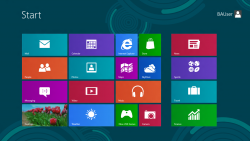 | |
| Windows 8 build 8400's Start Screen | |
| Codename(s) | '8' |
|---|---|
| Kernel version | NT 6.2 |
| CPU Architecture | x86, x64, ARM |
| Release date | 26th October 2012 |
| Licence | Microsoft EULA |
| Support end | Ended on 12th January 2016 |
| Other versions | |
| Previous: Windows 7 | Next: Windows 8.1 |
Windows 8 is a release of MicrosoftWindows, a family of operating systems developed by Microsoft. It was the successor to Windows 7.
History
Development of Windows 8 started before the general availability of Windows 7.
A Microsoft employee stated in his blog that Windows 8 will have the NT version number 7.0 and that the OS won't be shipped in a x86 version, but only as x64. However, the April 2011 leaks and PR from Microsoft indicated that the 32-bit Windows would continue and that the Windows 8 kernel version would be 6.2.
Steve Ballmer calls Windows 8 his "riskiest product bet" due to the high success of Windows 7.
At the CES 2011 in January 2011, a computer with an ARM processor was pictured running the "Windows 8" build 6.2.7867 showing that the kernel version had only changed to 6.2, most likely to keep compatibility with old software. It was determined to be an M2 build.
Four builds of Windows 8 in its early Milestone stages have been leaked: 6.1.7850 (M1), 6.2.7927 (M2), 6.2.7955 (M2), 6.2.7959 (Post-M2/Pre-M3), and 6.2.7989 (M3). Rumors show that because of the leaks of 7850, 7955, and 7959, two Microsoft employees were terminated due to leaking confidential software.
New/Improved features
- Immersive User Interface (referred to as Modern UI, codenamed Metro).
- Start screen which incorporates the Modern design language and replaces the Start menu of previous Windows versions, making it more touch-friendly.
- Internet Explorer 10 was introduced, which was also the first version to have a 'Metro' mode for touch-friendly usage. Adobe Flash was also bundled with Internet Explorer.
- Modern versions of Mail, Calendar, People and Reader were introduced, some replacing their Windows 7 desktop equivalents. A camera app was also introduced.
- Windows Explorer was renamed as File Explorer and the interface was changed to one based on the Ribbon system.
- New Desktop Window Manager features, such as support for software rendering, and performance improvements.
- File History, which automatically creates backups of files located across the system, was introduced.
- Reset and Refresh options were introduced (the former re-installs Windows, while the latter retains settings and removes desktop applications)
- Windows Store, which is a place where users can purchase and download Metro-based apps, was introduced.
- Windows to Go was introduced for the Enterprise edition, which allowed users to carry Windows in a flash drive or a removable hard drive.
- Task Manager was redesigned, now showing startup programs, average program use, and improved graphs.
- File transfers were improved, now allowing users to pause a transfer. The file transfer speed can also be shown as a graph.
- A new feature to improve boot times called Fast Boot was introduced, which significantly cut down on booting times.
- USB 3 is now natively supported.
- Snap was introduced, allowing 2 Metro apps to be on one screen together.
- Battery life was improved.
- Online integration was introduced in the form of Microsoft Account, allowing users to use that account to login in Windows.
- Improved support for cellular connectivity.
- Windows Defender was upgraded to support full antivirus protection, effectively replacing Microsoft Security Essentials.
- The lock screen was redesigned.
- Hyper-V is now available on 64-bit versions of Windows 8 Pro and Enterprise.
- The Windows Start orb was changed into a blue flatter trapezium based theme.
- Taskbar and window border colours can now be selected automatically.
- A new installer was introduced, which reduced restart times and significantly quickened the installation time.
Features removed or degraded
- The Start Menu (and the button) was removed, which created a huge backlash and could well be the biggest reason for the eventual failure of Windows 8.
- Windows 8 can no longer use unified search as was possible with Windows 7; instead you must search categorically.
- DWM is now on permanently and cannot be turned off, effectively removing themes such as the Classic and Aero Basic theme.
- Translucency and blurring was lost in the windows as a flatter theme was introduced instead.
- Metro apps require a minimum of 1024x768 and Snap required a minimum of 1366x768.
- Windows 8 now requires NX, SSE2 and PAE extensions on the processor and needs it to be enabled.
- Hyper-V requires SLAT for it to work on Windows 8.
Builds
- No information available
- Existence doubtful
- Information or pictures available
- Leaked or released
Milestone 1
Milestone 2
Milestone 3
Pre-Developer Preview
Offical Developer Preview - 6.2.8102
- 6.2.8102.101.winmain_win8m3.110830-1739 - Public Developer Preview
- 6.2.8102.101.winmain_win8m3.110831-1700 - KB2608612
- 6.2.8102.105.winmain_win8m3.110907-1505 - KB2616619
- 6.2.8102.106.winmain_win8m3.110908-1424 - KB2616150
- 6.2.8102.108.winmain_win8m3.110911-1502 - KB2617028
- 6.2.8102.109.winmain_win8m3.110912-1733 - KB2617868
- 6.2.8102.110.winmain_win8m3.110913-1848 - KB2618032
- 6.2.8102.112.winmain_win8m3.110915-1505 - KB2619246
Pre-Consumer Preview (Pre-Beta)
Consumer Escrow (Beta Escrow)
Offical Consumer Preview (Beta) - 6.2.8250
Release Preview
Post-RC Builds
Pre-RTM
RTM
Post-RTM
See Also
Windows 8
Windows 8
Source model
Final release
February 11, 2013
Released to manufacturing
General availability
Support status
Windows 8 is an operating system produced by Microsoft for use on personal computers, including home and business desktops, laptops, and tablets. It is part of the Windows NT family of operating systems, succeeds Windows 7 and precedes Windows 8.1 and Windows 10.
Development of this operating system started before the release of its predecessor in 2009. Its existence was first announced in January 2011 at Consumer Electronics Show. During its development and test phases, Microsoft released three pre-release versions: Developer Preview (September 13, 2011), Consumer Preview (February 29, 2012), and Release Preview (May 31, 2012). On August 1, 2012, Windows 8 graduated from the development stage and was released to manufacturing. Windows 8 is slated for general availability on October 26, 2012.
Windows 8 is built based on Metro design language and introduces a new form of "Windows 8-style software", which may only be obtained through Windows Store. Windows 8 also features a new start screen, Internet Explorer 10, native support for USB 3.0, a new Windows Defender that combats malware (instead of only spyware), Windows To Go, and support for UEFI SecureBoot. The last of these has stirred controversy.
Windows 8 is available in four major editions: Windows 8, Windows 8 Professional, Windows 8 Enterprise, and Windows RT 8, Windows Phone 8. The first three have almost the same hardware requirements as that of Windows 7. The latter, however, runs on tablet computers with ARM architecture and has different hardware requirements. Hardware vendors willing to receive Microsoft's certification for such devices need to adhere to a list of certification requirements. Windows 8 Enterprise and Windows RT will not be available at retail outlets.
Development
Early announcements
Windows 8 development started before Windows 7 had shipped[1] in 2009. In January 2011, at the Consumer Electronics Show (CES), that Microsoft announced that Windows 8 would be adding support for ARM microprocessors in addition to the x86 microprocessors from Intel, AMD and VIA.[2][3] On June 1, 2011, Microsoft officially unveiled Windows 8's new user interface as well as additional features at the Taipei Computex 2011 in Taipei (Taiwan) by Mike Angiulo and at the D9 conference in California (United States) by Julie Larson-Green and Microsoft's Windows President Steven Sinofsky.[4][5] A month before the BUILD conference was held, Microsoft opened a new blog called "Building Windows 8" for users and developers on August 15, 2011.[6]
Developer Preview
Microsoft unveiled new Windows 8 features and improvements on the first day of the BUILD conference on September 13, 2011.[7] Microsoft also released the Windows Developer Preview (build 8102) of Windows 8 the same day, which included SDKs and developer tools (such as Visual Studio Express and Expression Blend) for developing applications for Windows 8's new interface.[8] According to Microsoft, there were more than 500,000 downloads of the developer preview within the first 12 hours of its release.[9] The Developer Preview also introduced the Start screen. The Start button in the desktop opened the Start screen instead of the Start menu.
On 16 February 2012, Microsoft postponed the expiration date of the developer preview. Originally set to expire on 11 March 2012, this release is now set to expire on 15 January 2013 and expired.[10]
Consumer Preview
On 29 February 2012, Microsoft released Windows 8 Consumer Preview, the beta version of Windows 8, build 8250. For the first time since Windows 95, the Start button is no longer present on the taskbar, though the Start screen is still triggered by clicking the bottom-left corner of the screen and by clicking Start on the Charm bar.[11] Windows president Steven Sinofsky said more than 100,000 changes had been made since the developer version went public.[11] The day after its release, Windows 8 Consumer Preview had been downloaded over one million times.[12][13] Like the Developer Preview, the Consumer Preview is set to expire on January 15, 2013 and expired. People were not happy about the new Metro UI, and the fact that it had no start button.
Release Preview
At Japan's Developers Day conference, Steven Sinofsky announced that the Windows 8 Release Preview (build 8400) would be released during the first week of June.[14] On May 28, 2012, the Windows 8 Release Preview (Standard Simplified Chinese x64 edition, not China-specific version, build 8400) was leaked online on various Chinese and BitTorrent websites.[15] On May 31, 2012, the Windows 8 Release Preview was released to the public by Microsoft.[16]
Major items in the Release Preview included the addition of Sports, Travel, and News apps, along with an integrated version of Flash Player in Internet Explorer.[17] Unlike the Developer Preview and the Consumer Preview, the release preview is set to expire on January 16, 2013. But In late 2012, Microsoft released an update that postponed the date and like the Developer Preview and the Consumer Preview, the release preview is now set to expire on January 15, 2013 and expired.
Final version
On August 1, 2012, Windows 8 (build 9200[18]) was released to manufacturing.[19] Microsoft plans to release Windows 8 for general availability on October 26, 2012.[20] However, only a day after its release to manufacturing, a copy of the final version of Windows 8 Enterprise N (produced for European markets) leaked to the web and several days later there were Professional and Enterprise leaks both x86 and x64.[21][22] On August 15, 2012, Windows 8 was made available to download for MSDN, TechNet and DreamSpark subscribers.[23][24] Windows 8 was made available to Software Assurance customers on August 16, 2012.[25] Windows 8 was made available for student downloads (with a DreamSpark Premium subscription) on August 22, 2012, earlier than advertised.[24]
Relatively few changes were made from the Release Preview to the final version. A tutorial explaining how to use the new Metro interface was included and the look and feel of the desktop was subtly changed to be more in line with the Metro interface. Some Microsoft developed apps were also changed slightly.[26]
New features
Metro
Windows 8 employs a new user interface based on Microsoft's Metro design language. The Metro environment features a new tile-based Start screen similar to that of the Windows Phone operating system. Each tile represents an application, and can display relevant information such as the number of unread messages for an e-mail application or the current temperature on a weather application. These applications run in full-screen or in docked modes, and are able to share information between each other using "contracts".[27] They will be available only through Windows Store apps such as Facebook, Twitter, Netflix, iHeartRADIO, Rhapsody, Nick, Halo: Spartan Assault, Skype, Microsoft Solitaire Collection, Discovery Communications, Watch ABC, The New York Times, The Wall Street Journal, Amazon, NOOK, Angry Birds series, Cut the Rope, ESPN huluPLUS, Freshpaint, kindle, Wikipedia, VEVO, USA, TODAY, CNN, eBay, the CW, Ancestry, Zappos.com, FX Networks, Shazam, Crackle, Allrecipes, ABC Family, Wordament, HF: Brain Attack, Disney, CBS, Bank of America, TWC, AccuWeather, Audible, Foursquare, Flashcards Pro, Periodic Table, NBC, WWE, myHomework, 7-Eleven, Inc, StumbleUpon, OpenTable, Dictionary.com, Newegg, Zinio and MLB.TV.[28] Apps in the new interface are developed with the new Windows Runtime platform using various programming languages, including C++, Visual Basic, C#, and HTML with JavaScriptcode-behind.
The traditional desktop environment for running desktop applications is accessed via a tile on the new Start screen. The Start button has been removed from the taskbar in favor of a Start button on the new charm bar, as well as a hotspot in the bottom-left corner. Both open the new Start screen, which replaces the Start menu.[29]
Applications developed for this new environment were previously referred to as "Metro-style apps" in development materials, connecting it to Windows 8's use of a interface following the Metro design language as its primary desktop. However, reports surfaced that due to potential trademark issues with the German company Metro AG, Microsoft officials had begun to advise its Windows developers to stop using the term. A Microsoft spokesperson however, denied these reports and stated that the use of the term "Metro" to describe these apps was merely a codename that would be phased out.[30] Following these reports, Microsoft started using "Modern UI Style" to refer to its tile-based interface and design language.[31]
PowerShell 3.0
PowerShell is Microsoft's strategic task automation platform and a core component of the overall management framework for Windows. Version 3 has been in beta for some time but the final version is included with Windows 8 (and Windows Server 2012 which has also been released to manufacturing).
Other features
- Internet Explorer 10 is included as both desktop program and as a touch-optimized app. The latter does not support plugins or ActiveX components, but includes a version of Adobe Flash Player that is optimized for touch and low power usage and works only on sites included on a whitelist.[32]
- It is now possible to log into Windows using a Microsoft account (formerly known as a Windows Live ID). This will allow the user's profile and settings to be synchronized over the Internet and accessible from other computers running Windows 8, as well as integration with SkyDrive.[33]
- Windows Store will be the only method of purchasing and downloading Metro-style apps, as well as advertising desktop apps. Metro-style apps are installed from the Windows Store, or in the form of a Line Of Business app on devices joined in a network domain.[34]
- Two new authentication methods have been added: picture password, which allows users to log in by drawing three gestures in different places on a picture,[35][36] and PIN log in, which allows users to authenticate using a four digit pin.[37]
- File Explorer will include a ribbon toolbar, and have its file operation progress dialog updated to provide more detailed statistics, the ability to pause file transfers, and improvements in the ability to manage conflicts when copying files.[38]
- Hybrid Boot will use hibernation technology to allow faster startup times by saving the Windows core's memory to the hard disk and reloading it upon boot.[39][40][41]
- Windows To Go will allow Windows 8 Enterprise to boot and run from a bootable USB device (such as a flash drive).[42][43]
- Two new recovery functions are included, Refresh and Reset. Refresh restores all Windows files to their original state while keeping settings, files, and apps, while reset takes the computer back to factory default condition.[44]
- USB 3.0 is now supported natively.[45]
- A new lock screen displays a clock and notifications while the computer is locked.[46]
- Task Manager has been redesigned.[47]
- Xbox Live integration (including Xbox Live Arcade, Xbox SmartGlass, Xbox Music, and Xbox Video)[48]
- Storage Spaces will allow users to combine different sized hard disks into virtual drives and specify mirroring, parity, or no redundancy on a folder-by-folder basis.[49]
- Family Safety is intended to allow parents to protect their children on the Internet, as well as monitor and control their PC and Internet activities and usage.[50][51][52]
- Windows Defender now has anti-virus capabilities, similar to those of Microsoft Security Essentials. It is intended to replace the Security Essentials package and function as the default anti-virus program.[53]
Removed features
Lots of features have been removed in Windows 8, like the traditional Start menu. Support for playing DVD-Video has been removed from Windows Media Player due to the cost of licensing the necessary decoders and the prevalence of streaming services such as Netflix. For the same reasons, Windows Media Center is not included by default on Windows 8, but Windows Media Center and DVD playback support can be purchased in the "Professional Pack" (which upgrades the system to Windows 8 Professional) or "Media Center Pack" add-on for Windows 8 Professional. As with prior versions, third-party DVD player software can still be used to enable DVD playback.
Hardware requirements
The minimum system requirements for Windows 8 Enterprise edition are slightly higher than those of Windows 7.[54]
To run Metro-style apps, a screen resolution of 1024x768 or higher is required to run one app at a time, and a minimum resolution of 1366x768 is required to run two apps side-by-side using snap.[56]
Officially supported virtualization platforms for Windows 8 Consumer Preview included Hyper-V in Windows 8 Developer Preview, Hyper-V in Windows Server 2008 R2, VMware Workstation 8.2 for Windows, VirtualBox 4.1.8 for Windows, Parallels Workstation 6 for Windows, Parallels Desktop 4 for Windows, and XenDesktop 5.5.[57]
To receive logo certification, Microsoft requires that a system resume from standby in 2 seconds or less on x86 systems.[58]
Tablets/convertibles
Microsoft released minimum hardware requirements for new tablet and convertible devices designed for Windows 8, and defined a convertible form factor as a standalone device that combines the PC, display and rechargeable power source with a mechanically attached keyboard and pointing device in a single chassis. A convertible can be transformed into a tablet where the attached input devices are hidden or removed leaving the display as the only input mechanism.[59][60]
| Graphics Card | DirectX 10 graphics device with WDDM 1.2 or higher driver |
|---|---|
| Storage | 10GB free space, after the out-of-box experience completes |
| Standard buttons | 'Power', 'Rotation lock', 'Windows Key', 'Volume-up', 'Volume-down' |
| Screen |
kisatelevision’s blog

- Windows 8 Release Preview Build 8400 Activator Key Free
- Windows 8 Release Preview Build 8400 Activator Key Crack

Today, Microsoft has made the Release Preview available for Windows 8.This is great news, since the Release Preview is Sinofsky-speak for Release Candidate (RC). Typically, in Microsoft development this is the last pre-release version of the product before it hits Release to Manufacturers (RTM). Then, the bits are ‘done’ and find their way to volume license customers, Original Equipment Manufacturers (OEMs) and after General Availability (GA) to you.The Release Preview of Windows 8 is available in 32bit and 64bit (x86-64) through the links below:ISO-file English 2,5 GBISO-file English 3,3 GB. Other languages and formats are available on.Product Key: TK8TP-9JN6P-7X7WW-RFFTV-B7QPFAs you might expect, there’s no download for the ARM-based Windows RT flavor of Windows 8.
Windows 8 Release Preview Build 8400 Activator Key Free
All indications are this version will not be released in the same time schedule of the above versions.The build number of the Windows 8 Release Preview is 8400. ©.All rights reserved.The information on this website is provided for informational purposes only and the authors make no warranties, either express or implied. Information in these documents, including URL and other Internet Web site references, is subject to change without notice. The entire risk of the use or the results from the use of this document remains with the user.Active Directory, Microsoft, MS-DOS, Windows, Windows NT, and Windows Server are either registered trademarks or trademarks of Microsoft Corporation in the United States and/or other countries. All other trademarks are property of their respective owners.Metro Theme created. Proudly powered.
Windows 8 Release Preview Build 8400 Activator Key Crack
How To Get Windows 8 Consumer Preview Product Key. Serial key for Windows 8 Release Preview Build 8400 can be found and viewed here.
kisatelevision
Источник: [https://torrent-igruha.org/3551-portal.html]What’s New in the Windows 8 Release Preview Build 8400 serial key or number?
Screen Shot

System Requirements for Windows 8 Release Preview Build 8400 serial key or number
- First, download the Windows 8 Release Preview Build 8400 serial key or number
-
You can download its setup from given links:

Windows 8 Release Preview Build 8400 serial key or number & Free Download

Windows 8 Release Preview Build 8400 serial key or number& Apps for Laptop & PC Free Download

Windows 8 Release Preview Build 8400 serial key or number
About Author
